

Passing the road test does not immediately give an Arizona teenager the same driving rules as an adult.
For the first six months with a graduated Class G license, state restrictions control three everyday decisions: how late the teen may drive, how many young passengers may ride along and when a phone may be used.
That matters in Maricopa, where many school, work and activity trips require a car. A late practice, an extra friend or a navigation change can turn into a violation if a family relies on memory instead of the current Motor Vehicle Division rules.
ADOT’s Oct. 19 safety reminder also puts the risk in perspective. Crash reports compiled by the state show 31 drivers ages 15 to 18 were killed on Arizona roads in 2025. That is a statewide count, not a Maricopa statistic, and it includes only drivers in that age band—not every teen affected by a crash.
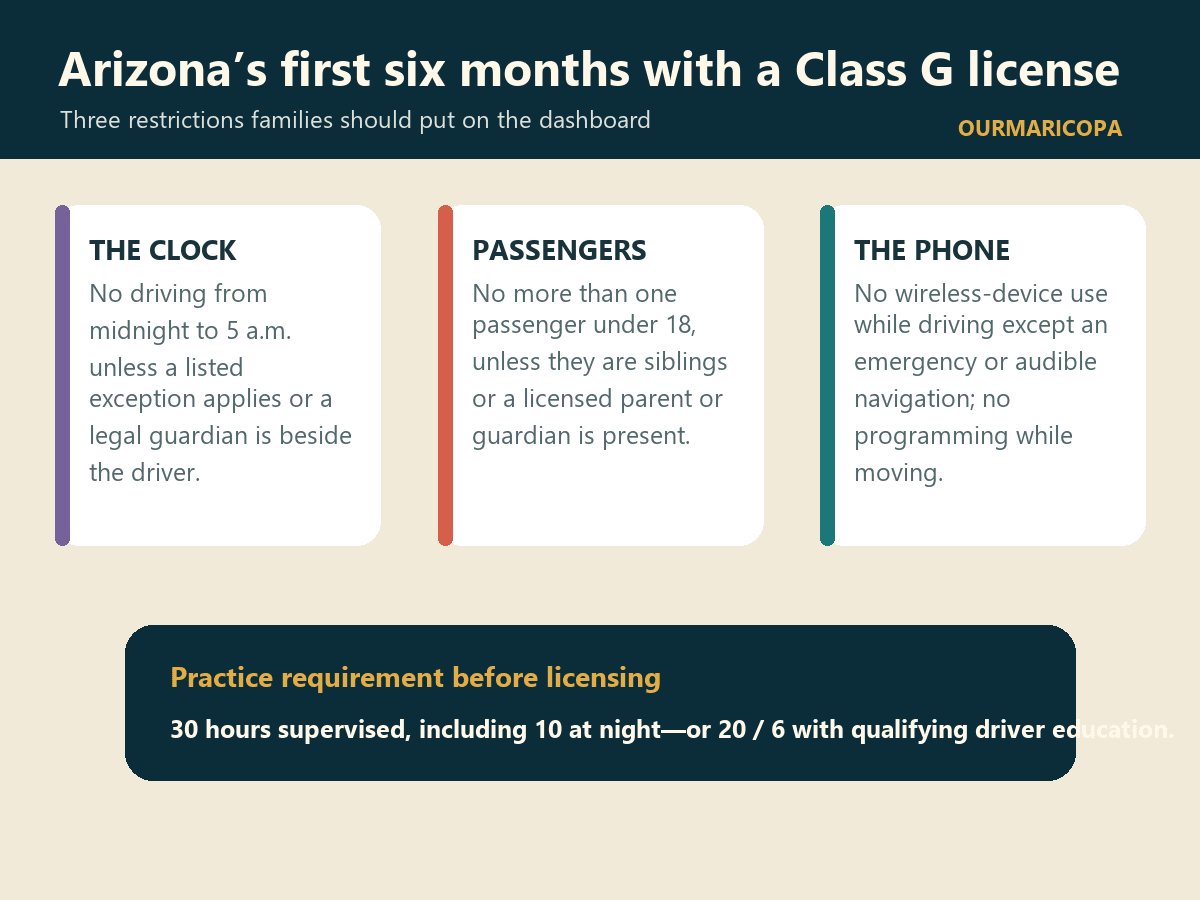
The clock: midnight to 5 a.m.
During the first six months, a Class G driver under 18 generally may not drive between midnight and 5 a.m.
MVD lists exceptions when a legal guardian with a valid driver license is seated beside the teen or when the teen is driving directly from a sanctioned school-sponsored activity, place of employment, sanctioned religious activity or family emergency.
“Directly” matters. A permitted drive home from work is not a blanket exception for unrelated stops. Families should plan pickup coverage for events that may run late and avoid asking a new driver to interpret a gray area from the roadside.
The passenger list: one person under 18
For those same first six months, the teen may not drive with more than one passenger under age 18.
There are two key exceptions: the under-18 passengers are the driver’s siblings, or a parent or legal guardian with a valid license is seated beside the driver.
The rule is not simply “one friend.” A car with several young passengers can become distracting even when everyone is behaving normally. Before a group leaves school or practice, decide who is riding with whom rather than putting the new driver in charge of negotiating the rule in the parking lot.
The phone: emergency or audible navigation only
MVD says a graduated driver may not use a cell phone or other wireless communication device while driving except in an emergency or to operate an audible navigation system. Programming the navigation while driving is prohibited.
The practical family rule should be stricter and easier to remember: set the route before moving, place the phone out of reach and pull over safely before changing anything. A red light is still part of the drive, not a phone break.
Arizona’s broader hands-free law also applies to drivers. A device mounted in the vehicle does not make every interaction safe or legal.
Before the license: supervised hours still count
Arizona allows a teen to begin the permit process at 15 years and 6 months. The instruction permit must generally be held for six months before the teen can qualify for the graduated license.
MVD lists three experience paths. The standard practice-and-road-test route requires at least 30 hours of supervised driving, including 10 hours at night. A teen who completes a qualifying driver-education program may use a 20-hour practice route with six night hours and a road test. A qualifying high-school or private driver-education course can provide a third path in which the road test is waived when current proof requirements are met.
The adult supervising permit practice must be a licensed driver age 21 or older seated beside the teen.
Violations can extend the restricted period
MVD lists escalating consequences for violations of the graduated-license restrictions:
A first conviction can bring a maximum $75 fine and extend the Class G restrictions by 30 days.
A second can bring a maximum $100 fine and a 60-day extension.
A third can bring a maximum $100 fine and a 30-day license suspension.
Additional rules and penalties may apply. Families dealing with a citation should use the official court and MVD instructions for that case rather than treating this guide as legal advice.
A Maricopa family checklist
Put the midnight rule and passenger limit somewhere the teen can see them. Make a late-event pickup plan. Practice the routes the teen will actually drive, including school, work, SR 347 approaches and nighttime neighborhood turns. Ask the teen to narrate hazards instead of merely accumulating hours.
OurMaricopa’s SR 347 commuter guide can help families review the corridor’s official cameras and alerts. The City, water and AZ511 alert guide explains how to build a verified alert routine, and the new-resident guide provides broader local orientation.
The license is a milestone. The first six months are still a training period—and Arizona writes that training period into the rules.
Sources
Arizona Department of Transportation — “ADOT supports Teen Driver Safety Week” — https://azdot.gov/news/adot-supports-teen-driver-safety-week — published Oct. 19, 2026; accessed Oct. 27, 2026.
Arizona Motor Vehicle Division — “Teen Driver Guide to Class G Permit and License” — https://azdot.gov/mvd/services/driver-services/teen-drivers/permit-and-license-requirements — accessed Oct. 27, 2026.
Arizona Motor Vehicle Division — “Teen License Restrictions Flyer” — https://apps.azdot.gov/files/mvd/mvd-forms-lib/18-298-teen-license-restrictions.pdf — accessed Oct. 27, 2026.