Santa Rosa Elementary’s English-Spanish classrooms have earned one of Arizona school boards’ signature honors.
Maricopa Unified School District announced late this week that Santa Rosa’s Dual Language Immersion program was named a 2026 Golden Bell Award winner by the Arizona School Boards Association. The district credited the students, staff and families who have built the program.
The recognition puts a statewide spotlight on a program designed to do more than teach a second language as a stand-alone subject. Santa Rosa students learn core academic content in both English and Spanish, with the long-term goals of bilingualism, biliteracy, grade-level achievement and cultural competence.
What the award recognizes
ASBA describes its Golden Bell Awards as recognition for student-oriented programs that show outstanding success and growth. The association accepts entries in four categories and names one award in each category.
ASBA’s public award page had not yet posted the complete 2026 winner list when this story was prepared, so the winner announcement here is attributed to MUSD’s first-party statement. The district’s announcement identifies Santa Rosa’s Dual Language Immersion program as a 2026 winner; it does not, on the accessible post, specify the competition category or publish the judges’ scoring.
Those details matter because an award headline should not outrun the public record. What is already clear is that the local program has been selected for statewide recognition by the school-boards association.
How Santa Rosa’s program works
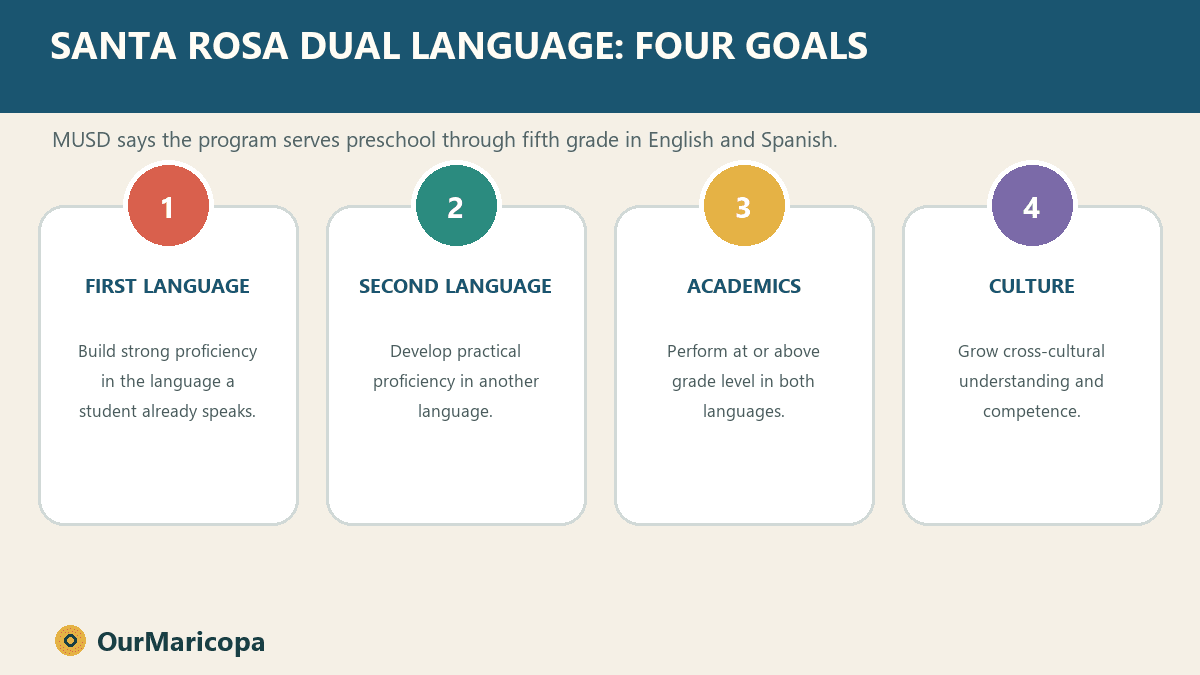
MUSD says the program serves preschool through fifth grade at Santa Rosa Elementary. Students learn in English and Spanish from certified teachers using a research-based curriculum.
The district lists four central aims:
proficiency in a student’s first language;
proficiency in a second language;
academic performance at or above grade level in both languages; and
cross-cultural understanding and competence.
That model differs from a short daily language lesson. In a dual-language program, both languages are part of the academic day and become tools for learning subjects, communicating and solving problems.
The district’s frequently asked questions say the program is intended to support both native English speakers and native Spanish speakers. It also describes preschool, kindergarten and first grade as the key entry years, with later entry depending on a student’s language background and program fit.
What families should know now
MUSD’s current open-enrollment page lists Santa Rosa as enrolling students in the Dual Language Immersion program for kindergarten through fifth grade for the 2026–27 year. That listing is useful, but it is not a guarantee that every grade or classroom still has a seat today.
Families interested in the program should confirm current capacity and entry requirements directly with the district or Santa Rosa Elementary. The school’s main number is 520-568-6150.
Questions worth asking include:
Which grades currently have space?
What language screening or placement process applies to older students?
How is instruction divided between English and Spanish by grade?
What support is available for families who speak only one of the two languages?
How does transportation work for open-enrollment students?
The award also arrives as Maricopa families weigh a growing menu of school programs and construction plans. OurMaricopa’s new-resident guide gives broader community context, while the site’s SR 347 commuter guide can help families think through daily travel. Neither guide replaces current enrollment information from MUSD.
A local program with a statewide signal
Awards do not answer every parent question about outcomes, staffing or long-term capacity. They do signal that a program’s work has cleared a statewide review and stood out among other submissions.
For Santa Rosa, the Golden Bell is also a reminder that language learning is not happening at the edge of the school day. It is built into the way participating students learn, read, write and work together from preschool through elementary school.
MUSD said simply, “¡Bravo, Santa Rosa Elementary!” The next useful public details will be the full ASBA winner citation, the award category and any program data the district releases to show the growth behind the honor.
Sources
Maricopa Unified School District — official Facebook announcement, “¡Bravo, Santa Rosa Elementary!” — https://www.facebook.com/MUSD20/posts/1739750538156299 — posted Oct. 23, 2026; accessed Oct. 25, 2026.
Maricopa Unified School District — Dual Language Immersion — https://www.musd20.org/departments/academic-services/signature-programming/dual-language-immersion — accessed Oct. 25, 2026.
Maricopa Unified School District — Dual Language Immersion FAQs — https://www.musd20.org/departments/academic-services/signature-programming/dual-language-immersion/dual-language-immersion-faqs — accessed Oct. 25, 2026.
Maricopa Unified School District — Open Enrollment — https://www.musd20.org/enroll/open-enrollment — updated Sept. 1, 2026; accessed Oct. 25, 2026.
Arizona School Boards Association — Golden Bell Awards — https://azsba.org/services-resources/awards/golden-bell-awards/ — accessed Oct. 25, 2026.