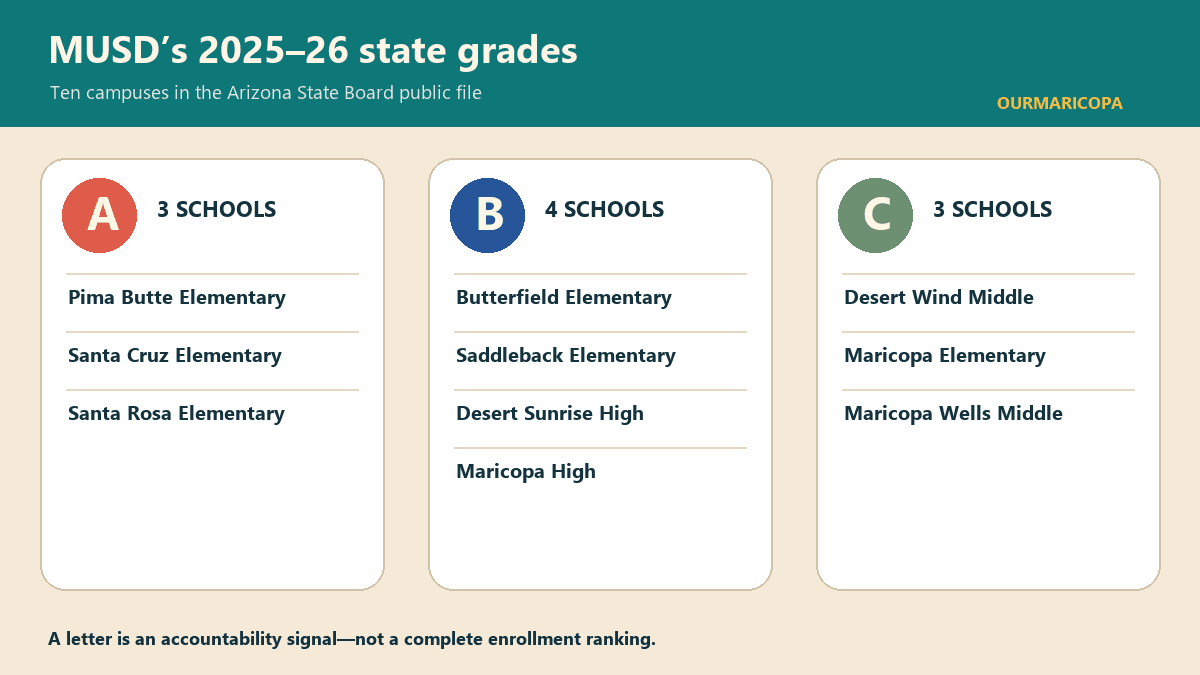
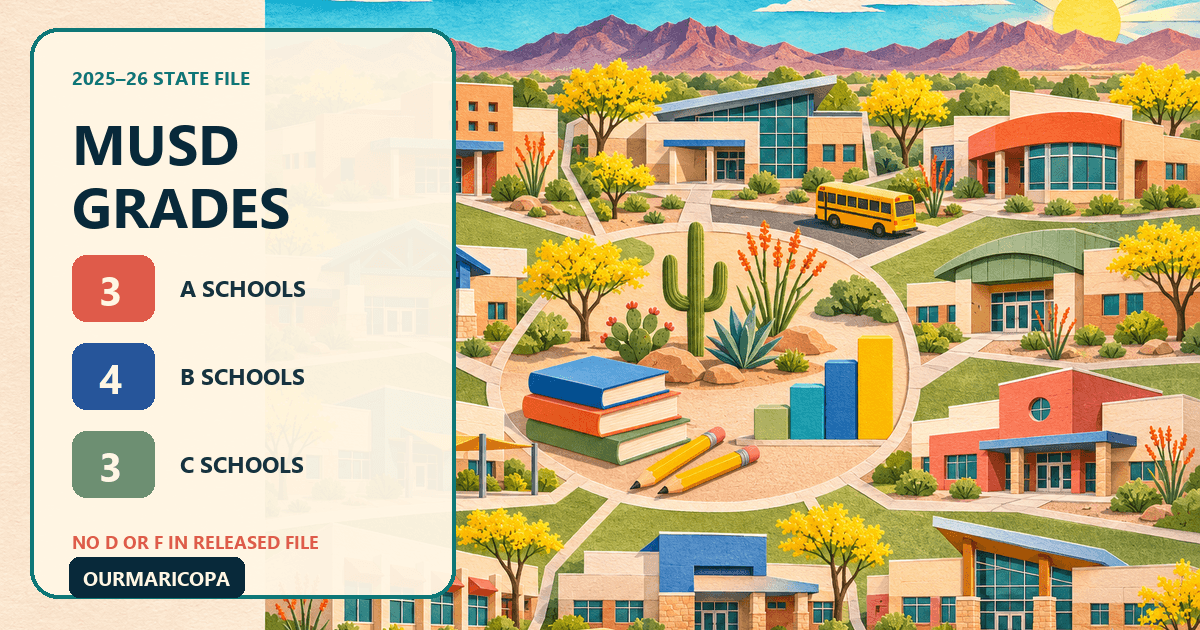
Arizona’s new school-grade file gives Maricopa Unified School District a clean A-through-C spread: three A schools, four B schools and three C schools.
No MUSD campus received a D or F in the State Board of Education’s 2025–26 public file released Oct. 27.
The grades cover 10 district schools. They are useful accountability signals, but they are not a complete ranking of everything families care about. Arizona’s formulas combine achievement, academic growth and other model-specific measures; they do not directly score school culture, every program, transportation reliability or whether a campus is the right fit for one child.
The three A schools
The public file assigns an A to:
Pima Butte Elementary School
Santa Cruz Elementary School
Santa Rosa Elementary School
Four campuses earned B grades
The state assigns a B to:
Butterfield Elementary School
Saddleback Elementary School
Desert Sunrise High School
Maricopa High School
Both district high schools in the released file are therefore in the B group. The other two B grades belong to elementary campuses.
Three campuses received C grades
The state assigns a C to:
Desert Wind Middle School
Maricopa Elementary School
Maricopa Wells Middle School
A C is not the same as an F, and the state file should not be turned into a social-media label about students or teachers. It is an accountability result that can help families and district leaders decide what questions to ask next.
What Arizona’s letters measure
Arizona law requires an annual A-F achievement profile for public schools. The State Board publishes different models for K–8, 9–12, alternative schools and online schools because the available outcomes differ by grade span.
For K–8 schools, the model includes measures such as proficiency, academic growth, English-learner performance and acceleration/readiness indicators. The high-school model also incorporates graduation and college-and-career-readiness measures.
That is why two schools with the same letter can have different strengths underneath it. A headline grade does not reveal whether a campus earned more of its result from student growth, proficiency, graduation or another component.
Families who want the next layer should use Arizona’s School Report Cards site and select the individual campus. The report-card pages provide the component context that the statewide spreadsheet cannot fit into one row.
What the list does—and does not—say
The released spreadsheet lists the MUSD campuses above and their official 2025–26 letter grades. It does not justify adding a grade to a campus or program that is not in the file. An omitted school should not be described as failing.
It also would be a mistake to treat these letters as an enrollment order from first to tenth. Families may weigh boundaries, special education services, dual-language programming, athletics, transportation, class offerings and daily travel differently.
OurMaricopa’s school-bus tracking coverage explains a separate question families may weigh: how the district is testing transportation updates. The new-resident guide also points families toward official enrollment and boundary sources. Neither question is answered by a letter grade alone.
The useful takeaway
The state’s 2025–26 release gives MUSD a distribution with no campus below C: three A’s, four B’s and three C’s.
That is the clean snapshot. The responsible next step is to open the school-level report card, compare the underlying components and ask what each campus is doing with the result—not to reduce an entire school community to one letter.
Sources
Arizona State Board of Education, “A-F School and LEA Letter Grades,” 2025–26 accountability page; accessed Nov. 1–2, 2026: https://azsbe.az.gov/schools/a-f-school-letter-grades
Arizona State Board of Education, “FY 26 Combined A-F Public File,” version dated Oct. 27, 2026; accessed Nov. 1, 2026: https://azsbe.az.gov/sites/default/files/2026-10/FY%2026%20Combined%20A-F%20Public%20File%202025-10-27_v2.xlsx
Arizona Department of Education, “AZ School Report Cards”; accessed Nov. 2, 2026: https://azreportcards.azed.gov/
Image credit: Original OurMaricopa editorial illustration created with OpenAI image generation. The campus mosaic is conceptual and does not depict a specific school.