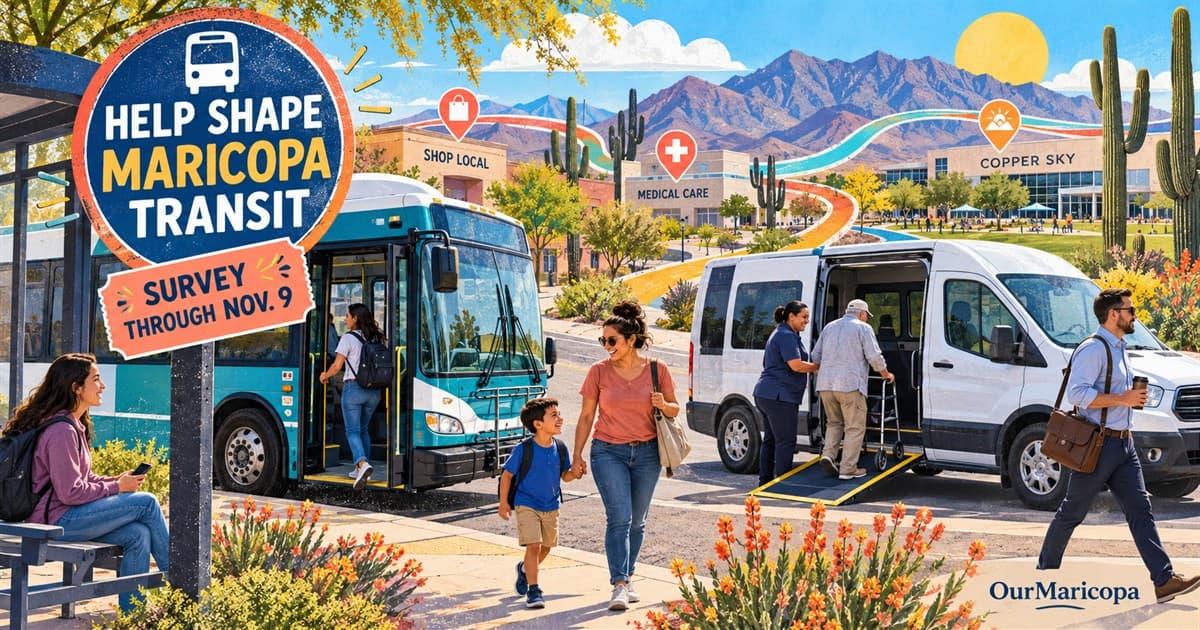
Maricopa residents now have a chance to weigh specific transit choices rather than answer only a general question about whether the city needs more transportation options.
The City of Maricopa and the Maricopa Association of Governments have opened the second public-input phase of the Maricopa Transit Study. An online survey available through Monday, Nov. 9 asks residents to review and rank possible improvements involving fixed-route buses, on-demand microtransit and longer-term regional connections.
The survey is for current riders and people who do not use transit. That matters because a useful system has to account for the trips people cannot make today, not only the riders already on board.
What is being studied
The official pages describe three broad groups of alternatives:
refinements or expansions to fixed-route service;
changes or expansion for microtransit; and
long-term connections to the larger region.
Those are categories under review, not approved routes or funded projects. The study team is asking residents which alternatives should receive priority before it moves toward final recommendations.
Maricopa currently operates an hourly circulator through Maricopa Express Transit, serving shopping, medical, education, park and community destinations. The City added an on-demand curb-to-curb microtransit service in 2024 for same-day trips within city limits, according to the MAG project page.
The current study is measuring how those services perform, comparing MET with peer systems, reviewing ridership and operating data and gathering public input. It began in summer 2025 and is expected to conclude in spring 2027.
How to take part
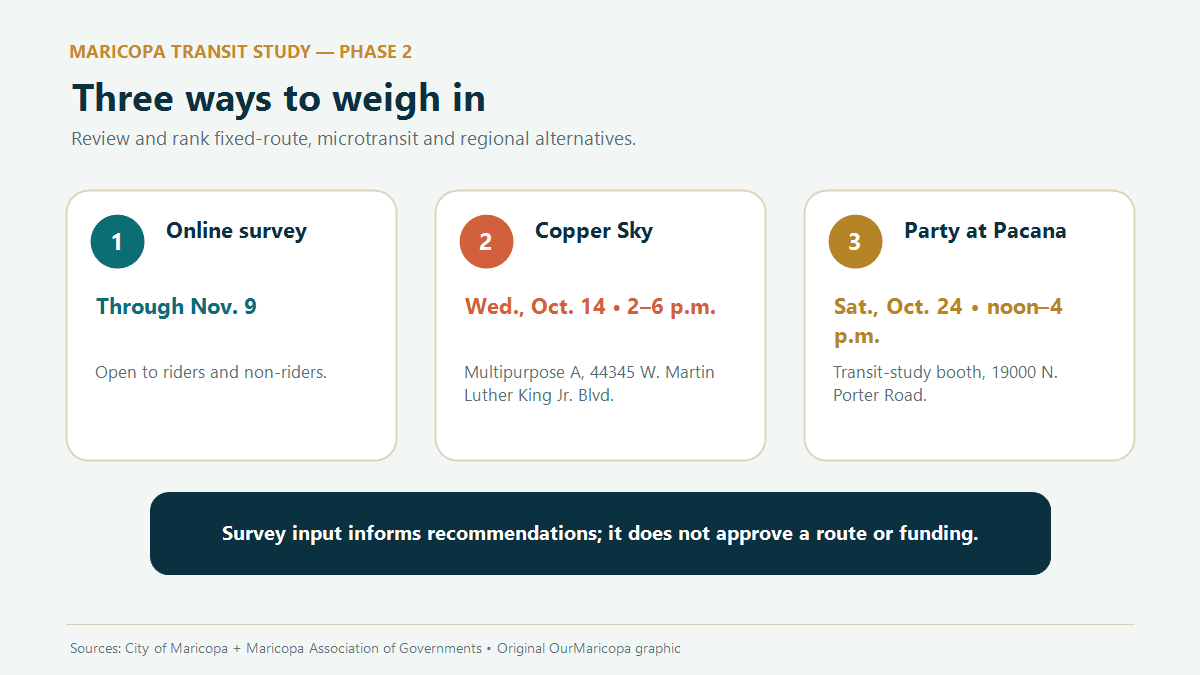
The online transit survey is available through Nov. 9. The MAG study page also provides the project schedule, current-service background and a place to sign up for updates.
Residents can meet the team at two October drop-ins:
Wednesday, Oct. 14, 2–6 p.m. — Copper Sky Multigenerational Center, Multipurpose A, 44345 W. Martin Luther King Jr. Blvd.
Saturday, Oct. 24, noon–4 p.m. — the transit-study booth at Party at Pacana, 19000 N. Porter Road.
There is no set presentation time. Residents can arrive during the posted window to review the alternatives, ask questions and offer feedback.
One source detail needs care: the City's news release labels Oct. 14 as a Tuesday, but Oct. 14, 2026 falls on a Wednesday, and MAG's project page lists Wednesday. This draft uses Wednesday. Anyone making a special trip should recheck the official study page before leaving.
Questions worth considering before answering
A better survey response is tied to an actual trip. Residents may want to think about:
Which destination is difficult to reach without a car?
Is the barrier the route, the wait, the service hours or the distance to a stop?
Would a fixed schedule or an on-demand pickup work better for that trip?
Are connections outside the city more important than added local stops?
What would make the service usable for an older adult, a person with a disability, a student or a worker with an early or late shift?
Those questions help turn a broad preference into information a planner can compare.
Residents can use OurMaricopa's community calendar to coordinate the two outreach dates. The community and public services directory collects local government resources, while the SR-347 page and commuter guide help residents compare current driving conditions with other transportation needs.
What the survey will not decide by itself
A survey response is input, not a vote that authorizes a route. After outreach, the study still has to analyze alternatives, costs, operations and available funding before producing recommendations.
The agency name can also cause local confusion: the Maricopa Association of Governments is the regional planning agency working with the City of Maricopa. The city itself is in Pinal County, not Maricopa County.
That distinction does not change who should participate. Anyone whose daily life is affected by transportation in Maricopa can give the study team a more complete picture before the Nov. 9 deadline.
Sources
City of Maricopa: What Would Make Getting Around Maricopa Easier?. Published Sept. 25, 2026; accessed Oct. 1, 2026.
Maricopa Association of Governments: MAG City of Maricopa Transit Study. Accessed Oct. 1, 2026.
SurveyMonkey, on behalf of the study team: Maricopa Transit Study Survey. Accessed Oct. 1, 2026; deadline verified against the City and MAG pages.