

The text says an account will close in 10 minutes. The caller says a relative is in jail. A pop-up claims your computer has been hacked, and the “technician” needs remote access now.
The story changes. The pressure tactic does not.
For Maricopa residents, the most useful fraud defense is not memorizing every scam. It is recognizing when someone is trying to prevent you from stopping, checking and talking to another person.
The FBI’s 2025 Internet Crime Complaint Center report shows why that pause matters. People age 60 and older filed more than 201,000 complaints and reported $7.748 billion in losses. The average reported loss was $38,500, and more than 12,400 complainants said they lost at least $100,000.
Those are national reports, not a count of Maricopa victims. They do show the scale of a problem that can reach any phone, inbox or social-media account.
Four pressure tactics that should stop the conversation
Urgency: The caller creates a deadline so there is no time to think. Real agencies and financial institutions can have deadlines, but a surprise demand for immediate payment deserves independent verification.
Secrecy: The person says not to tell family, bank staff, police or another government agency. The FBI identifies secrecy as a common way scammers isolate victims.
Unusual payment: Gift cards, cryptocurrency, wire transfers, cash in a box or precious metals are not normal ways to settle a government penalty, protect an account or pay bail to a stranger.
Authority without verification: Caller ID, a logo and personal details are not proof. Numbers can be spoofed, websites can be copied and publicly available information can make a fake story sound personal.
Government-impersonation scams can be especially effective because they mix fear with apparent authority. The FBI says criminals may claim a victim’s identity is connected to a crime, threaten arrest and then offer a fake “safe” account or government vault. A real law-enforcement agency will not ask residents to protect money by sending cash, gift cards or cryptocurrency.
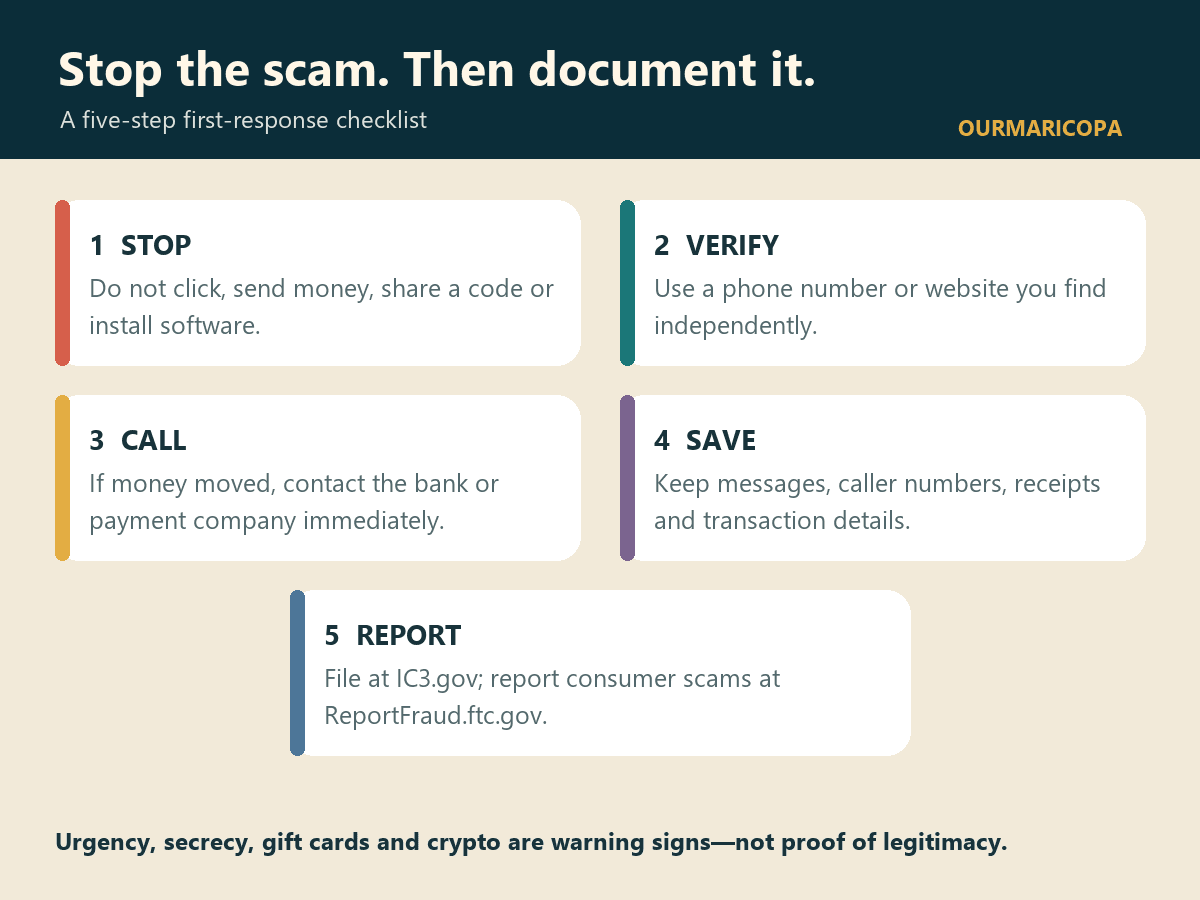
The five-minute response plan
1. Stop the transaction. Do not click a link, share a one-time code, install software or move money while the caller is waiting. End the call if necessary.
2. Verify through a route you find yourself. Use the number on the back of a bank card, an official statement or a government website typed directly into the browser. Do not use the number or link supplied by the suspicious message.
3. Call the financial institution immediately if money moved. Tell the bank, card company, wire service, cryptocurrency exchange or payment app that the transfer may be fraudulent. Speed does not guarantee recovery, but delaying can reduce the available options.
4. Save the evidence. Keep the message, email headers, phone number, payment receipt, wallet address, account name, dates and a short timeline. Do not keep engaging just to collect more information.
5. Report it. Internet-enabled fraud can be reported at IC3.gov. Consumer scams can also be reported at ReportFraud.ftc.gov. If there is an immediate threat or a crime in progress, call 911. For a non-emergency City of Maricopa police matter, MPD lists 520-568-3673.
What to tell a family member who feels embarrassed
Shame helps the criminal. It can delay a bank call, erase evidence and keep the same pitch working against other people.
Start with the practical questions: Is a transfer pending? Did anyone receive a password or one-time code? Was remote-access software installed? Which account needs to be secured first? Avoid turning the first conversation into an argument about how the scam worked.
The FBI’s examples make an important point: education and professional experience do not make someone immune. Modern scams combine research, emotional pressure, spoofed technology and long conversations. The target is not foolish; the manipulation is deliberate.
Build the pause before the next call
Families can agree on a private verification phrase for urgent calls involving money. Banks can add transaction alerts. Phones and email accounts should use unique passwords and multifactor authentication. A household can also write down the bank’s real fraud number before an emergency.
OurMaricopa’s guide to City, water and AZ511 alerts can help residents distinguish official notification channels from an unsolicited message. The MPD camera-registration guide explains a separate voluntary program; it does not give police live access to a home camera. New residents can use the Maricopa newcomer guide to identify local agencies before a crisis.
The rule worth remembering is short: urgency is a reason to slow down, not speed up. End the conversation, find the real organization independently and ask one more person before money leaves the account.
Sources
Federal Bureau of Investigation — “Scammers Target Older Adult Victims” — https://www.fbi.gov/news/stories/scammers-target-older-adult-victims — published May 15, 2026; accessed Oct. 27, 2026.
FBI Internet Crime Complaint Center — “2025 IC3 Annual Report” — https://www.fbi.gov/file-repository/2025_ic3report.pdf — released 2026; accessed Oct. 27, 2026.
Federal Bureau of Investigation — “Resources for Victims of Financial Fraud” — https://www.fbi.gov/how-we-can-help-you/victim-services/resources-for-victims-of-financial-fraud — accessed Oct. 27, 2026.
Federal Trade Commission — “ReportFraud” — https://reportfraud.ftc.gov/ — accessed Oct. 27, 2026.
City of Maricopa Police Department — “Dispatch & Communications” — https://www.maricopa-az.gov/Departments/Police-Department/Dispatch-Communications — accessed Oct. 27, 2026.