
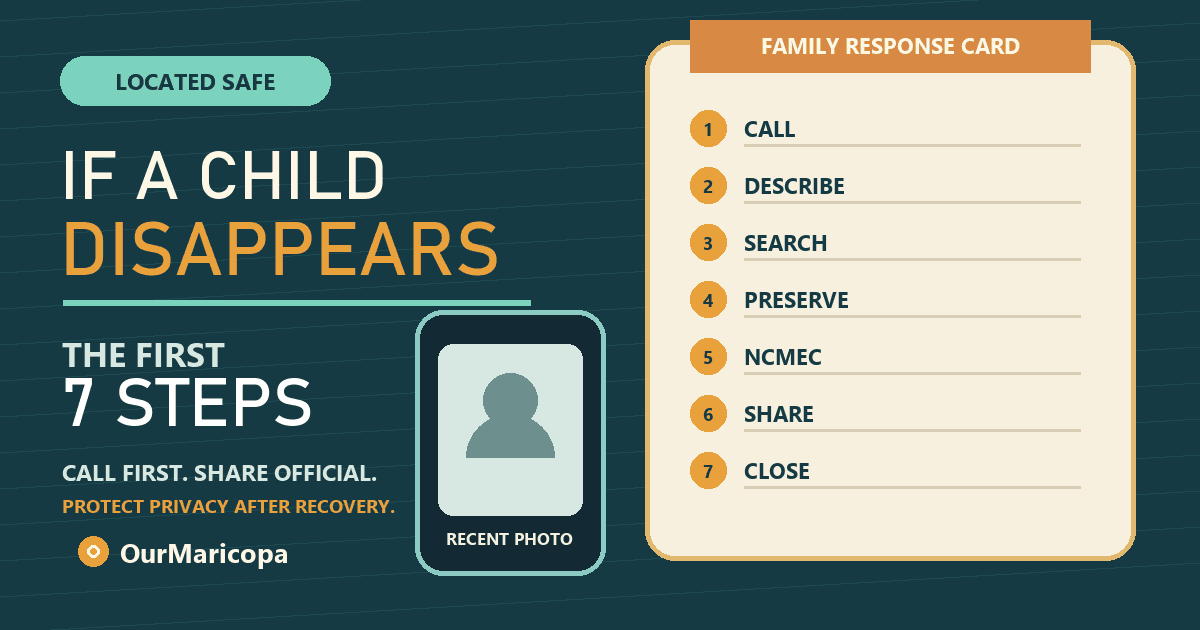
Maricopa Police delivered the update every family wants to see: located safe.
The department’s public Facebook notice said a 12-year-old reported missing from a local group home had been found. MPD thanked people who shared the information. With the search over, the responsible next step is to stop circulating the child’s photo and personal details and take a broader lesson from the alert: families should know what to do before panic takes over.
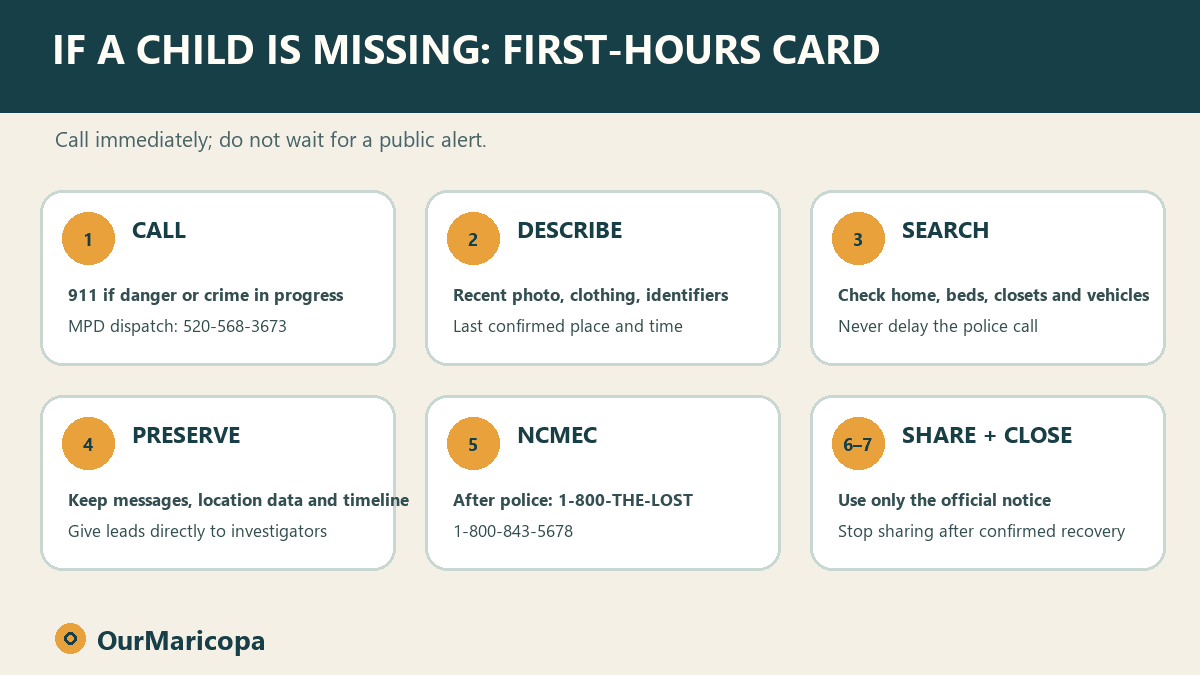
This is not a guide to deciding whether a case “deserves” an AMBER Alert. That decision belongs to law enforcement. It is a first-hours checklist built from the National Center for Missing & Exploited Children, Arizona law and Maricopa Police contact guidance.
1. Call law enforcement immediately
Do not wait 24 hours. NCMEC says to contact local law enforcement immediately when a child is missing.
In Maricopa, call 911 when there is immediate danger, a suspected abduction, a crime in progress or another life-threatening emergency. MPD’s non-emergency dispatch line is 520-568-3673 for situations that are not life-threatening. If you are unsure which number fits, call and let the dispatcher triage the situation rather than losing time trying to solve that question yourself.
The City says dispatchers need the location first. Give the address, nearby cross streets, landmarks or business names as clearly as possible.
2. Give a precise, current description
Prepare the child’s full name, date of birth, height, weight, hair and eye color, distinguishing features, clothing and shoes. Tell dispatch exactly when and where the child was last seen and who last saw them.
Have a recent, clear photograph ready. A school portrait may be useful, but a current phone photo that accurately shows hair, glasses, braces or other identifiers can be even more practical.
NCMEC advises families to ask that the child’s identifying information be entered into the FBI’s National Crime Information Center Missing Person File. Arizona law already requires a law-enforcement agency receiving a missing-child report to submit the available information to Arizona and national crime-information systems within two hours.
3. Search likely hiding places without delaying the call
If the child disappeared from home, NCMEC recommends checking closets, laundry piles, beds, large appliances, vehicles and trunks, and other places where a child could crawl or hide.
The key is timing: make the police call first or have one adult call while another searches. Do not send the whole household in different directions without a plan. Keep one person available to answer dispatchers and responding officers.
If the child goes missing in a store or public venue, notify the manager or security office and call law enforcement immediately. Many stores use a Code Adam response, but store procedures do not replace a police report.
4. Preserve the information investigators may need
Write down the last confirmed time, location and circumstances while memories are fresh. Keep the child’s phone, account information, recent messages and location-sharing data available for investigators. Do not delete, alter or publicly post material that could matter to the case.
Make a short list of friends, relatives, familiar places, transportation options and anyone who may have seen the child. Give that information directly to law enforcement. Avoid conducting confrontational interviews or entering private property on your own.
5. Call NCMEC after making the police report
After contacting law enforcement, call the National Center for Missing & Exploited Children at 1-800-THE-LOST (1-800-843-5678). The 24-hour center can coordinate with the investigating agency, help create and distribute posters, review leads and connect families with support.
NCMEC is a second call, not a substitute for local police.
6. Share only the official notice
Public sharing can help, but inaccurate posts can waste time or expose a child unnecessarily. Use the exact post or poster issued by the investigating agency or NCMEC. Do not add theories, alleged sightings, private addresses or unverified names.
Send tips to the number on the official notice, not to a neighborhood comment thread. A “seen near” comment can spread fast without ever reaching investigators.
Maricopa residents can also strengthen their general alert setup with OurMaricopa’s guide to the City, water and AZ511 alert systems. Those systems are useful for community notifications, but no alert subscription should delay a direct call about a missing child.
7. Close the loop when the child is found
Follow the investigating agency’s direction. Once police confirm the child is safe, stop sharing the active alert. Delete downloaded copies when they are no longer needed and avoid repeating private circumstances that officials did not release.
The safe update in Maricopa is the best possible ending. The lasting value is a simple household plan: know the numbers, keep a recent photo, know what information to give and move immediately.
Sources
City of Maricopa Police Department, “UPDATE: LOCATED SAFE” on the department’s authenticated Facebook page, original/update dates visible Oct. 23–24, 2026; accessed Oct. 24, 2026: https://www.facebook.com/MaricopaPD/posts/pfbid0qqZtJMurV4AVboF7xcfa8LtoAWE5jKHhZnN95gXnQJ1hSx7isbvRgew8RjMBb52Wl
City of Maricopa Police Department, “Dispatch & Communications,” current contact and 911 guidance; accessed Oct. 24, 2026: https://www.maricopa-az.gov/Departments/Police-Department/Dispatch-Communications
National Center for Missing & Exploited Children, “Is Your Child Missing?”; accessed Oct. 24, 2026: https://us.missingkids.org/MissingChild
Arizona State Legislature, A.R.S. § 8-901, “Missing, kidnapped or runaway children; mandatory reporting; training”; accessed Oct. 24, 2026: https://www.azleg.gov/ars/8/00901.htm