

Maricopa residents get the easy part of the nationwide time change: do not turn the clock back on Sunday, Nov. 1.
Most of Arizona remains on Mountain Standard Time throughout the year. The City of Maricopa stays at UTC−7, so the local wall clock does not move when daylight saving time ends elsewhere at 2 a.m.
The confusing part is everything connected to another state.
California, Colorado and most of the country will fall back one hour. That changes Maricopa’s time difference with friends, offices, airports, television schedules and recurring online meetings—even though nothing changes on a clock inside a Maricopa home.
California moves one hour behind Maricopa
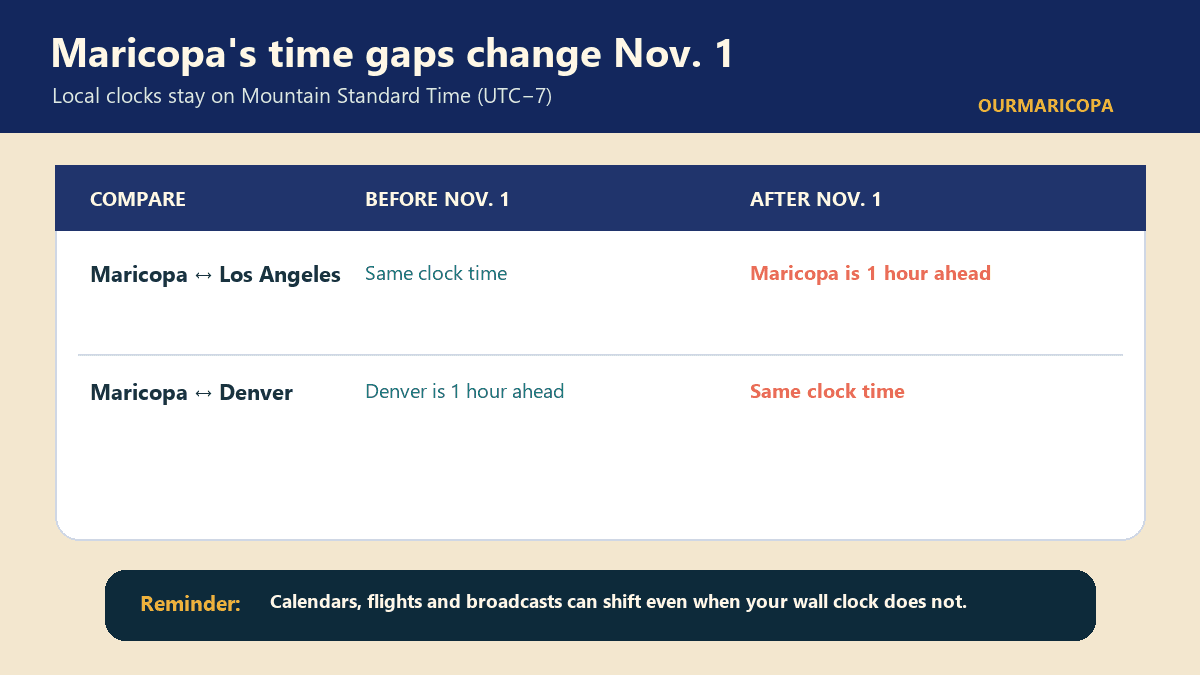
Before Nov. 1, California is on Pacific Daylight Time, UTC−7. That puts Los Angeles and Maricopa on the same clock time during the summer season.
After the transition, California returns to Pacific Standard Time, UTC−8. Maricopa will then be one hour ahead of Los Angeles.
A 9 a.m. Maricopa call that was also 9 a.m. in California becomes an 8 a.m. California call after Nov. 1—unless the calendar invitation is anchored correctly to a named time zone.
Denver moves onto the same time as Maricopa
Colorado observes daylight saving time. Before Nov. 1, Denver is on Mountain Daylight Time, UTC−6, which is one hour ahead of Maricopa.
After the transition, Denver returns to Mountain Standard Time, UTC−7. Denver and Maricopa will then show the same clock time.
This is why the generic phrase “Mountain Time” can cause trouble in Arizona. It may refer to a region that switches between daylight and standard time, while Maricopa stays on standard time year-round.
Three things to check before Sunday
1. Recurring work and school meetings
Open any recurring event that involves another state and confirm which time zone controls it. A meeting saved as “9 a.m. Arizona” behaves differently from one saved as “9 a.m. Pacific.”
If a calendar description contains only “MT,” ask whether the organizer means Arizona time or the clock used in a Mountain state that observes daylight saving time.
2. Flights and connections
Airline schedules display departure and arrival times in each airport’s local time. The printed duration can look different after a seasonal shift even when the actual flight length has not changed.
Use the airline’s current itinerary, not a manually calculated time difference. This is especially important for California departures and connections through cities that do change clocks.
3. Live broadcasts and appointment reminders
A national sports broadcast listed in Eastern or Pacific time will appear one hour different in Maricopa after the transition. Automated appointment reminders can also be confusing if an account or device is set to a generic Mountain zone instead of an Arizona/Phoenix zone.
Residents should review the time-zone label on phones, computers, smart-home devices and work profiles. The safe setting is the location-based Arizona or Phoenix option when available—not a guess based only on the word “Mountain.”
The Arizona exception has an exception
The federal time resources note that most of Arizona does not observe daylight saving time, except the Navajo Nation. That exception matters for travel in northeastern Arizona, but it does not change clocks in Maricopa.
For a trip through tribal lands in northeastern Arizona, check the destination’s current local time directly rather than relying on a statewide assumption. For ordinary Maricopa life, the rule is much simpler: local time remains fixed. What changes is the relationship to places that move.
Residents planning cross-state travel can pair this guide with the SR 347 commuter guide. Newcomers may also want the moving-to-Maricopa guide, while time-sensitive local events remain on the OurMaricopa calendar.
So when Sunday arrives, leave the Maricopa wall clock alone. Check the calendar invite instead.
Sources
National Institute of Standards and Technology — “Daylight Saving Time (DST).” https://www.nist.gov/pml/time-and-frequency-division/popular-links/daylight-saving-time-dst. Page last updated Oct. 7, 2025; accessed Oct. 29, 2026. Source for the Nov. 1, 2026 end date, 2 a.m. transition and Arizona exception.
National Institute of Standards and Technology — “Local Time FAQs.” https://www.nist.gov/pml/time-and-frequency-division/local-time-faqs. No page date shown; accessed Oct. 29, 2026. Source for Mountain Standard Time’s UTC−7 offset and daylight-time context.
U.S. Department of Transportation — “Daylight Saving Time.” https://www.transportation.gov/regulations/daylight-saving-time. No page date shown; accessed Oct. 29, 2026. Source for federal oversight and the Arizona/Navajo Nation exception.
National Institute of Standards and Technology — time.gov. https://www.time.gov/. Accessed Oct. 29, 2026. Official U.S. time reference used to verify the Arizona time-zone presentation.