
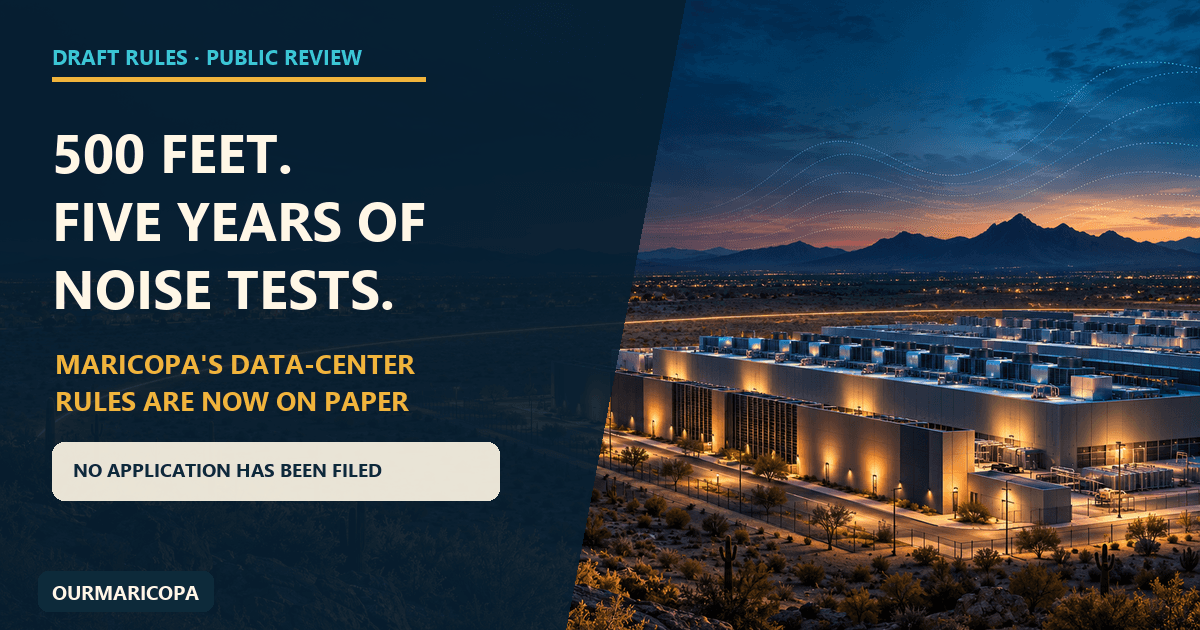
Maricopa has put its first detailed data-center rulebook on paper—and the numbers are unusually specific.
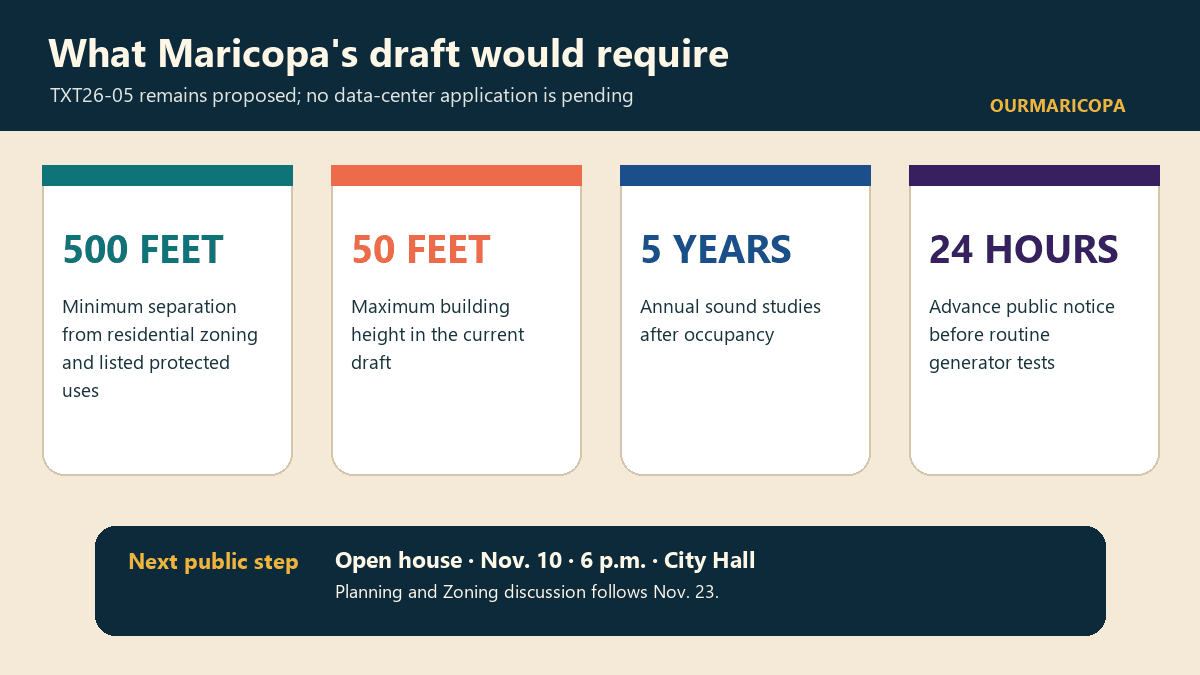
The City’s first draft calls for a 500-foot buffer from residential zoning and several protected public uses, a 50-foot building-height limit, sound studies before occupancy and every year for five years afterward, and 24-hour public notice before routine backup-generator testing.
Just as important: this is a proposal, not an approval. In a comment on its official Facebook page Thursday night, the City said it has not received any application for data-center development. The standards are being written proactively, before a project lands at City Hall.
Residents get their first in-person look at the proposal Tuesday, Nov. 10, at 6 p.m. at City Hall.
Where a principal data center could go
The draft would not make a large, stand-alone data center an ordinary permitted use anywhere in the city. A principal-use data center would need to be specifically authorized through a City Council-approved Planned Area Development, or PAD, and then receive a Conditional Use Permit.
That distinction matters. A PAD and a conditional-use review create public decision points; they do not guarantee that a future application would be approved.
The draft also allows a narrower accessory data center in Light Industrial and Industrial Park zoning with a conditional-use permit. That smaller facility would have to serve the on-site enterprise, could not provide services to third parties and could occupy no more than 15% of the development’s gross floor area.
Residents following any future proposal should compare the application’s label with the actual use. “Accessory” and “principal” data centers would face different rules.
The 500-foot buffer has a defined boundary
Under the current draft, a data-center building would have to sit at least 500 feet from residential zoning and from listed public or semi-public uses. The protected-use list includes day-care centers, hospitals and clinics, parks and recreation facilities, religious or social-service facilities, and schools.
That is a building-separation rule—not a five-mile exclusion zone and not a blanket ban on every industrial parcel. The distance should be measured against the final site plan if an application ever arrives.
The draft would also cap buildings at 50 feet and impose facade, screening and fencing standards. Buildings larger than 50,000 square feet would have a public-art requirement. Loading and service areas would need to be placed and screened to reduce their visibility from roads and homes.
Noise rules reach beyond the opening day
The proposal requires an independent baseline acoustic study, including low-frequency sound and infrasound. It then sets maximum sound levels at the affected property line based on the neighboring zoning.
For residential property, the draft lists 55 decibels both day and night. Commercial and office property would be capped at 65 decibels during the day and 60 at night. The draft defines daytime as 6 a.m. to 7 p.m.
Before a facility could receive a certificate of occupancy, another sound study would have to show compliance. If the limits were exceeded, additional mitigation would be required. The operator would then need annual sound studies for five years.
Routine generator testing would be limited to weekdays from 9 a.m. to 5 p.m., except for emergencies and certain demand-response circumstances. The draft also calls for the City and the public to receive at least 24 hours’ notice before a routine test.
Those provisions do not promise silence. They create measurement, notice and enforcement points that residents could use to judge whether a future facility complies.
The utility section asks for capacity evidence—not a water cap
Water and electricity are likely to dominate the public conversation, but the draft does not establish a simple gallon or megawatt ceiling.
Instead, it would require written confirmation from the applicable utility providers addressing available capacity, infrastructure needs, limitations, expected annual consumption and any off-site improvements. It also assigns the data center the full cost of undergrounding adjacent or on-site electrical infrastructure when the City determines that work is necessary.
A future applicant’s utility letters would therefore be essential reading. They would show what providers say is available and what upgrades are needed; they would not, by themselves, prove that every community concern has been resolved.
The proposal also requires a Community Benefit Plan for a principal-use data center. The draft establishes the obligation to submit a plan, but residents should wait for an actual application before assuming what benefits would be offered.
Four public dates, four different stages
The City’s review schedule separates discussion from possible action:
Nov. 10: public open house and feedback, 6 p.m.
Nov. 23: Planning and Zoning Commission discussion only, 6 p.m.
Dec. 14: Planning and Zoning Commission possible action, 6 p.m.
Jan. 19, 2027: City Council public hearing and possible action, 6 p.m.
All four are listed for City Hall, 39700 W. Civic Center Plaza. Residents can also email Development Services at `dsd@maricopa-az.gov`.
The City’s current development map is useful for understanding the difference between projects in review, approved and under construction. For a broader planning framework, OurMaricopa’s Proposition 414 guide explains why a general plan does not approve an individual project. The earlier commercial design-guidelines guide shows another City code proposal moving through its own review sequence.
The immediate decision is not whether to welcome or reject a specific data center. There is no application to decide. The immediate question is whether these draft standards are strong, clear and enforceable enough before the first proposal arrives.
Sources
City of Maricopa — “Maricopa Seeks Input on Proposed Data Center Standards.” Published Oct. 29, 2026; accessed Oct. 30, 2026. https://www.maricopa-az.gov/Maricopa-eNews/Open-House-on-Proposed-Zoning-Amendment
City of Maricopa — “Draft Zoning Code — Data Center Regulations,” Draft No. 1 dated Oct. 28, 2026; accessed Oct. 30, 2026. Linked from the City notice above.
City of Maricopa official Facebook page — data-center standards post and City reply stating no application has been received. Posted Oct. 29, 2026; accessed Oct. 30, 2026. https://www.facebook.com/CityOfMaricopaAZ/posts/pfbid02TUNany2aSEUSJnAdhHa8C4Mcsfowk3BJQ7UPmK9f26cCHib8t6s4aNuVZ88jxduzl
Cover: Original AI-generated editorial illustration by OurMaricopa. It depicts a conceptual data-center campus, not an existing or proposed Maricopa project.