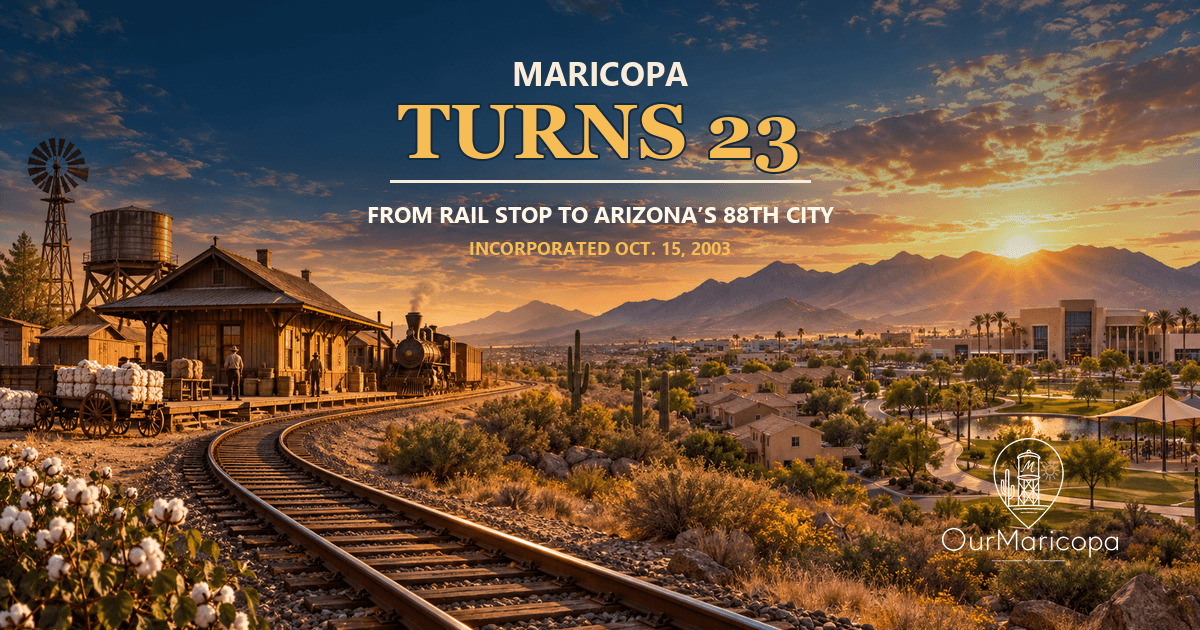
Maricopa marks 23 years as an incorporated city on Thursday, Oct. 15. The anniversary connects two very different versions of the same place: a transportation and agricultural community that counted 1,040 residents in the 2000 Census, and a city that now estimates its population at about 82,400.
The City incorporated on Oct. 15, 2003, becoming Arizona’s 88th municipality. That date gave Maricopa residents a municipal government of their own, with locally elected leadership and direct responsibility for city services, land-use decisions and community planning.
The community came before the city
Maricopa’s story did not begin in 2003. The City’s history page traces the community through several locations and names tied to transportation routes. Early settlements served travelers along the Gila River, and the eventual rail junction helped connect freight, agriculture and people moving through the region.
Cotton, farming and the railroad remain part of the community’s visual identity. They also explain why Maricopa’s annual Stagecoach Days celebration runs during the city’s incorporation-anniversary season.
The anniversary is therefore a useful dividing line, not the beginning of local history. It marks the point when a long-established community became a municipal government.
The growth happened fast
The City’s history page lists 1,040 residents in the 2000 Census and says the community reached 15,934 residents two years later. Today, the City’s population and demographics page uses an approximate population of 82,400.
Those figures come from different points and methods, so they should not be read as a single Census-to-Census comparison. They do show the scale and pace of change that shaped modern Maricopa.
The same City page describes a municipality of about 43 square miles inside a much larger 233-square-mile planning area. That difference matters when residents see a project or neighborhood described as “Maricopa.” A Maricopa mailing address, the City limits and the broader planning area are not always the same boundary.
What incorporation changed
Incorporation created a City Council and a local organization responsible for municipal decisions. Today that includes public safety, parks, streets, planning, development review, code enforcement and other City services.
It did not make every public service a City department. Water, sewer, electric, gas and solid-waste service still involve separate utilities and providers. The companion utility-provider draft in today’s package explains how to identify the correct company for an address.
That distinction also appears in development coverage. A proposal may be inside the City, outside the City limits but within a planning area, or before Pinal County rather than the City Council. The responsible government and the project’s review stage both need to be confirmed before describing it as approved or under construction.
A city still defining its next chapter
Recent official data illustrate the pressure created by continued growth. The City reports active residential and commercial development, new road planning and a steady need for schools, recreation, utilities and public-safety capacity.
Permits and project maps help residents follow that work, but they need context. OurMaricopa’s report on 244,660 square feet of commercial permits covers aggregate activity without turning permitted space into a list of promised openings. The development-map draft in today’s package explains why “in review,” “under construction” and “recently completed” are different claims.
The anniversary is a chance to hold both sides of Maricopa’s identity at once: the rail-and-agriculture roots that predate incorporation, and the modern city managing the consequences of rapid growth.
Three numbers to remember
Oct. 15, 2003: Maricopa’s incorporation date.
88th: Maricopa’s place in the order of Arizona municipalities.
About 82,400: The approximate population currently listed by the City.
These are City figures, not a prediction about how large Maricopa will become. Future growth depends on housing, infrastructure, water, schools, employment and decisions that are still being reviewed.
At 23, Maricopa is young as a city and much older as a community. Its next chapter will be measured by how well local institutions keep pace with the place residents have built.
Sources
City of Maricopa — History of Maricopa. https://www.maricopa-az.gov/Our-City/History-of-Maricopa. Accessed Oct. 15, 2026.
City of Maricopa — Population & Demographics. https://www.maricopa-az.gov/Our-City/Populations-Demographics. Accessed Oct. 15, 2026.
City of Maricopa — General Plan, Introduction. https://www.maricopa-az.gov/Departments/Development-Services/Planning-Maricopa-General-Plan/I-Introduction. Accessed Oct. 15, 2026.
City of Maricopa — Making History in Maricopa. https://www.maricopa-az.gov/Maricopa-eNews/Making-History-in-Maricopa. Accessed Oct. 15, 2026.
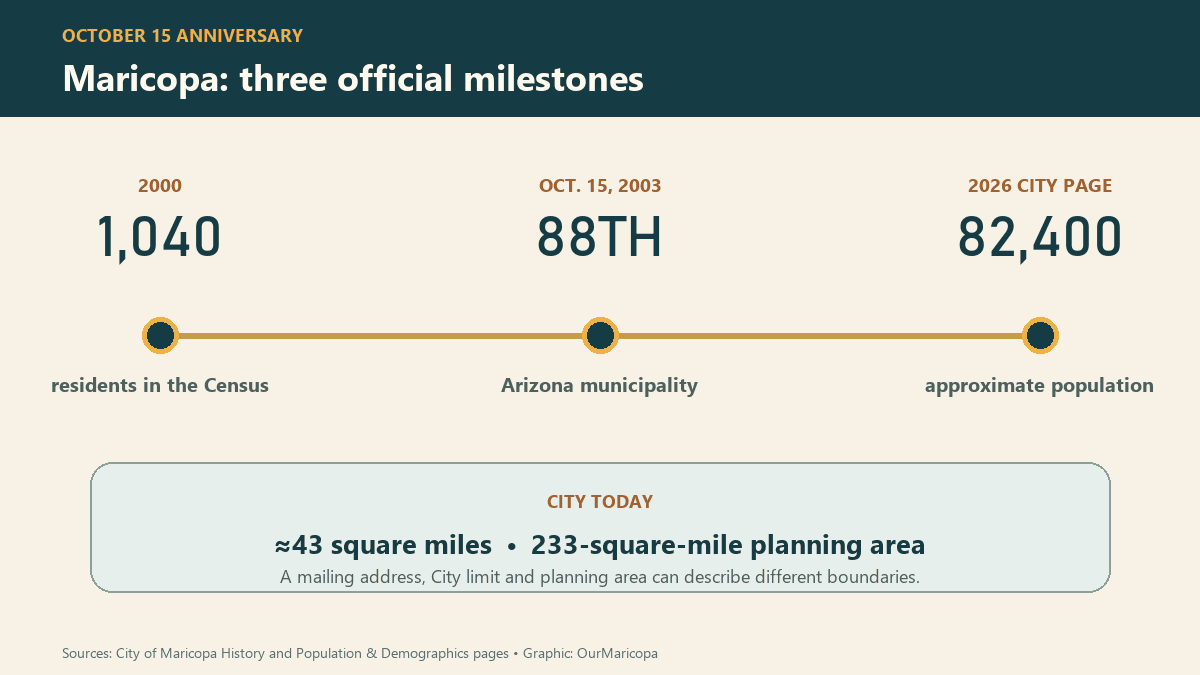
Three official City milestones show the scale of Maricopa’s change. Photo: OurMaricopa graphic based on City of Maricopa history and population pages