

A crash photo, a row of police vehicles or a neighborhood post can tell you something happened. It cannot tell you what police found, whether anyone was arrested or what charge—if any—was filed.
Maricopa residents have a special search trap: the city is in Pinal County, not Maricopa County. Searching the wrong county can produce official-looking results about an entirely different jurisdiction.
Here is a practical route from “I saw police activity” to information that can actually be attributed.
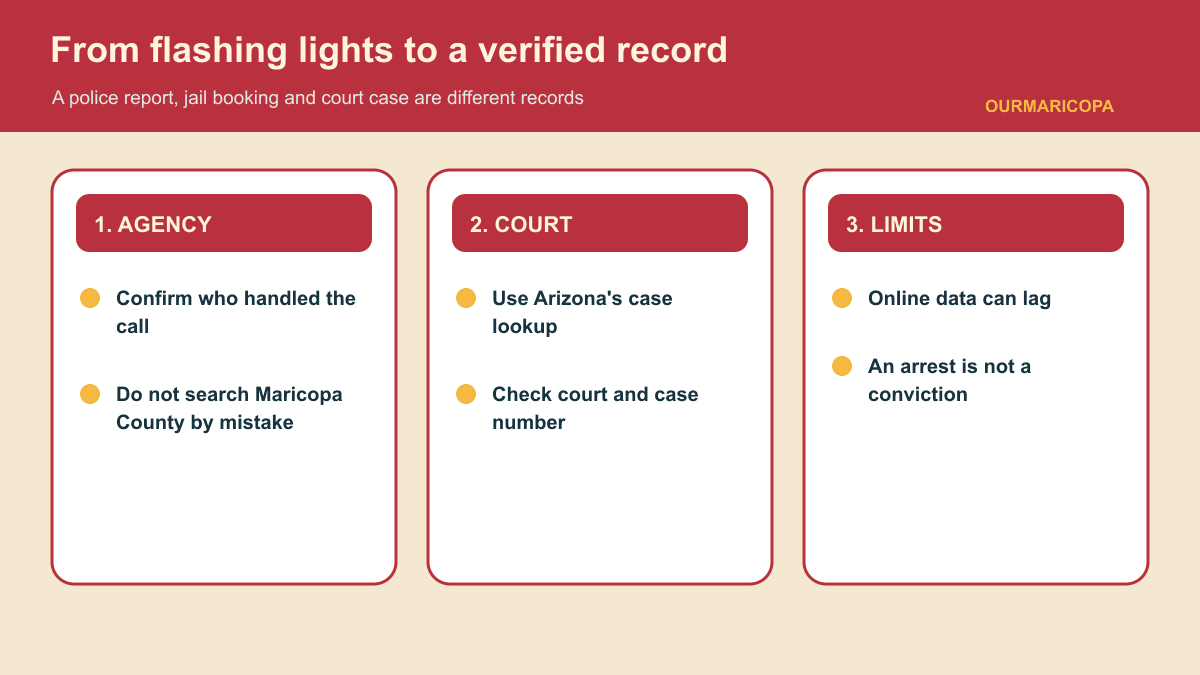
Start with the agency, not the rumor
If the event happened inside the City of Maricopa, begin with the Maricopa Police Department. Its Records Unit processes the department’s reports and public-records requests. The City says the department generates more than 20,000 reports a year.
The records page warns that timing varies by record type. Noncriminal incidents and crash reports can usually be released within five days or when legally authorized. Criminal reports can require redaction and may take longer. An absence from a same-day search is not proof that nothing happened.
For an active emergency, call 911. The City lists 520-568-3673 for non-emergency dispatch. A records request is for documentation; it is not the way to report an urgent threat.
Know which record answers which question
An incident report answers what responding officers documented. A crash report records a traffic collision. A jail record can show custody information. A court docket shows a filed case and later proceedings.
Those records do not appear at the same moment. A person can be detained without a public court case immediately appearing. A prosecutor can file charges that differ from the initial arrest allegation. A case can be dismissed or end in an acquittal. “Arrested” and “convicted” are never interchangeable.
For basic case information, the Arizona Judicial Branch offers a statewide Public Access to Court Information search covering most Arizona courts. The system itself cautions that its information may not be current, complete or the official court record. It excludes sealed matters and several protected case types, and local ordinance violations may not appear.
The Maricopa Municipal Court directs residents to that statewide tool for immediate online access. Written municipal-court record requests generally take seven to 10 business days, and fees can apply for name research, copies and certification.
For Pinal County Superior Court documents, the Clerk of the Superior Court accepts record requests and explains that sealed or confidential records are unavailable. The state’s eAccess portal provides online access to eligible Superior Court civil and criminal documents, generally for cases filed since July 1, 2010, with per-document or subscription fees.
Five checks before sharing a claim
Confirm the place. “Maricopa” can refer to the city, Maricopa County or even organizations with Maricopa in their name.
Confirm the agency. City police, tribal police, the Pinal County Sheriff’s Office, Arizona Department of Public Safety and school police keep different records.
Capture the source link. A screenshot without the page URL and timestamp is hard to verify and easy to misread later.
Separate allegation from outcome. Use “police allege” or “court records list” when that is all the record establishes.
Protect uninvolved people. Do not publish a home address, minor’s identity, medical information or a bystander’s face just because it appears in a neighborhood post.
What a responsible local report should say
If primary confirmation is unavailable, the honest description is “unverified.” That does not mean the lead is false. It means the evidence is not yet strong enough to publish as fact.
For developing incidents, useful reporting can still explain what is known, name the verification gap and state what record is being sought. What it should not do is turn an anonymous comment into an arrest claim or imply guilt from police presence alone.
The fastest post in a neighborhood feed often wins attention. The record-based post is the one readers can trust tomorrow.
Sources
City of Maricopa Police Department, “Police Records,” accessed Nov. 3, 2026: https://www.maricopa-az.gov/Departments/Police-Department/Support-Services/Police-Records
City of Maricopa Municipal Court, “Record Requests & Fees,” accessed Nov. 3, 2026: https://www.maricopa-az.gov/Departments/Maricopa-Municipal-Court/Record-Requests-Fees
Arizona Judicial Branch, “Public Access to Court Information,” accessed Nov. 3, 2026: https://apps.azcourts.gov/publicaccess/caselookup.aspx
Arizona Judicial Branch, “eAccess,” accessed Nov. 3, 2026: https://www.azcourts.gov/eaccess
Pinal County Clerk of the Superior Court, “Request Copies of Court Records,” accessed Nov. 3, 2026: https://www.coscpinalcountyaz.gov/166/Request-Copies-of-Court-Records