
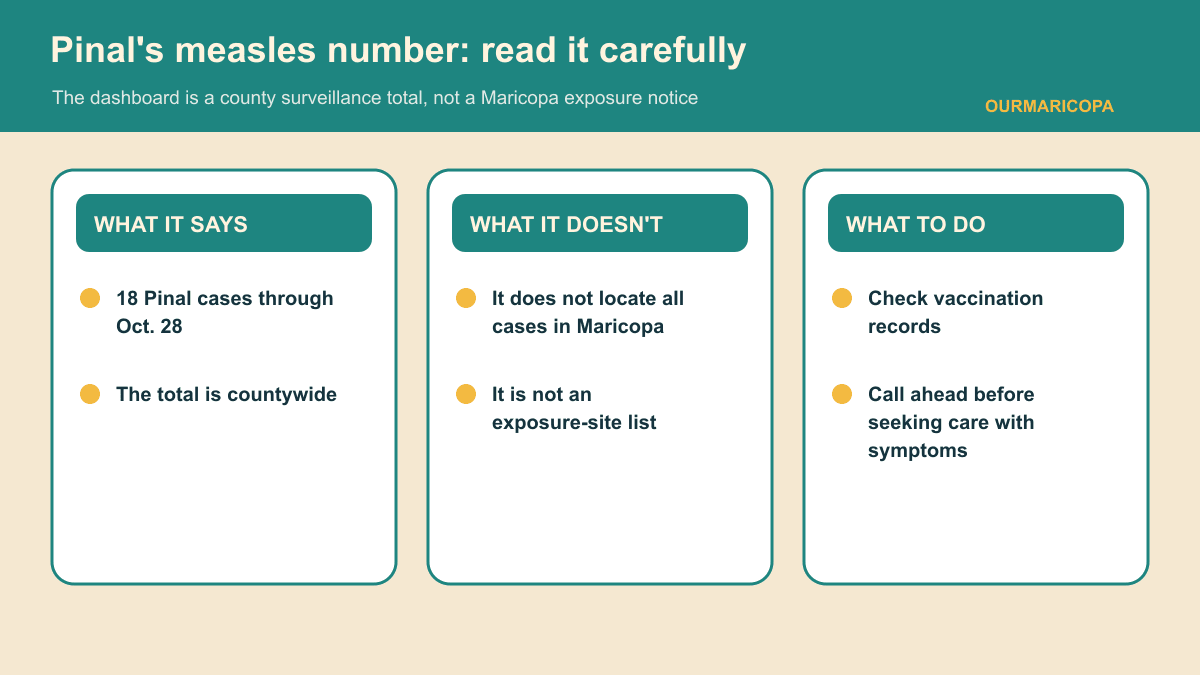
Pinal County’s public-health page now lists 18 reported measles cases for 2026 through Oct. 28. That is a real warning signal for families to check protection and recognize symptoms—but it is not evidence that 18 cases occurred in the City of Maricopa.
The distinction matters. The county publishes one surveillance total for all of Pinal County. Its current table does not break those 18 cases down by city, neighborhood, school or exposure location. The page also does not identify a new Maricopa exposure site.
Residents should take the number seriously without turning it into a claim the data does not support.
What the county number tells us
Pinal County’s “Current Illness Activity” table lists reported cases from Jan. 4 through Oct. 28. Along with 18 measles cases, the county lists 855 valley fever cases, 169 norovirus cases, 102 salmonella cases and 1,189 COVID-19 cases for the same period.
Those are surveillance totals. They help public-health officials and residents see that diseases are being reported in the county. They are not a live count of people who are currently contagious, and they do not automatically identify where an exposure happened.
Symptoms worth recognizing
The Centers for Disease Control and Prevention says measles commonly begins with a high fever, cough, runny nose and red or watery eyes. A rash usually follows, often beginning near the hairline and spreading downward.
Symptoms generally appear about one to two weeks after contact, though public-health guidance uses a longer monitoring window in some exposure situations. People can spread measles before the rash makes the illness obvious.
Because measles spreads through the air and can remain in a space after an infected person leaves, walking unannounced into a clinic can expose other patients. Anyone who thinks they or a child may have measles should call the medical provider before arriving. The provider can give instructions that reduce exposure in a waiting room.
Emergency symptoms such as trouble breathing, dehydration, confusion or a rapidly worsening illness require urgent medical care. Call ahead when possible so the receiving facility can prepare.
Check protection before there is an exposure notice
The CDC says two doses of the measles, mumps and rubella vaccine provide the best protection. Its current guidance lists two doses as about 97% effective against measles and one dose as about 93% effective.
Families who are unsure about vaccination records should contact their health-care provider or check available immunization records. Pregnancy, immune-system conditions, infancy and recent exposure can change the advice a person needs, so individualized medical guidance matters.
After a confirmed exposure, time can matter. The CDC says people who are not immune should contact a provider immediately because MMR vaccine or immune globulin may reduce the risk of developing measles in certain circumstances. That is not a reason to self-diagnose or seek a vaccine without discussing eligibility; it is a reason not to wait for symptoms before calling.
What would change this story
A City of Maricopa exposure notice, a school-specific notice or a new Pinal County release identifying locations would be a materially different development. None of those details appears on the county illness-activity page reviewed Nov. 3.
Until then, the accurate takeaway is narrower: measles has been reported in Pinal County this year, vaccination records are worth checking, and fever-plus-rash symptoms deserve a call ahead to a medical provider.
This article provides general public-health information and is not a diagnosis or substitute for medical advice.
Sources
Pinal County Public Health, “Current Illness Activity in Pinal County,” updated Oct. 28, 2026, accessed Nov. 3, 2026: https://www.pinal.gov/734/Public-Health
CDC, “Measles: What to Do If You Get Sick or Exposed,” updated Aug. 5, 2026, accessed Nov. 3, 2026: https://www.cdc.gov/measles/if-sick-exposed/
CDC, “Measles Vaccine Recommendations,” updated March 3, 2026, accessed Nov. 3, 2026: https://www.cdc.gov/measles/hcp/vaccine-considerations/index.html
Arizona Department of Health Services, “Measles,” accessed Nov. 3, 2026: https://www.azdhs.gov/documents/preparedness/epidemiology-disease-control/investigations/sections/measles.pdf