
A new identification rule is in effect for people who bring documents to a Pinal County Recorder's Office in person.
Beginning Sept. 14, anyone presenting a document for recording at a Recorder's Office or recording kiosk must show a valid, unexpired government-issued photo ID, unless the submission falls within one of the exemptions in state law.
For Maricopa residents, the closest listed Recorder location is at 19955 N. Wilson Ave., Suite 100. The office is open Monday through Friday from 8 a.m. to 4:30 p.m. and lists 520-866-3958 as its local phone number.
Which IDs does Pinal County list?
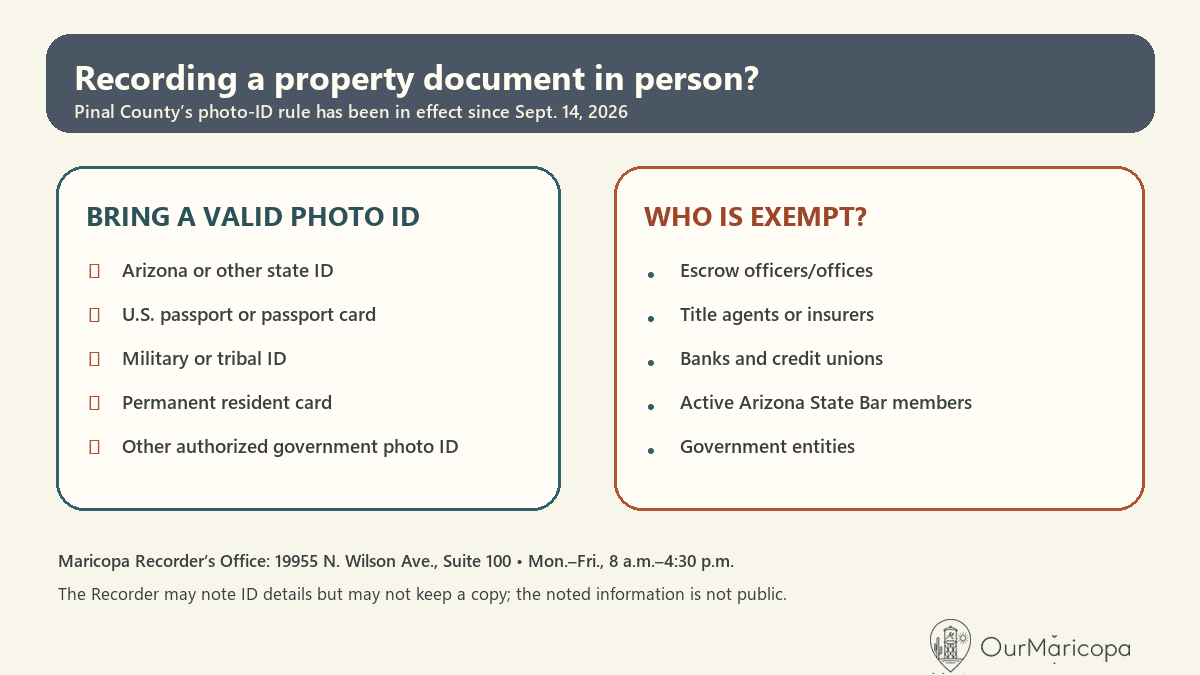
The Recorder's Aug. 13 notice gives these examples:
Arizona driver license
Arizona identification card
Driver license or identification card from another U.S. state or territory
U.S. passport or passport card
U.S. military identification card
Federally recognized tribal identification card
U.S. permanent resident card
Another valid government-issued photo ID authorized by Arizona law
The list is presented as examples, not a promise that every card with a photograph will qualify. If the document is time-sensitive or the ID is unusual, call the Recorder before visiting.
Pinal County's in-person recording ID checklist and statutory exemptions. | Photo: OurMaricopa graphic based on Pinal County Recorder and Arizona law.
Who is exempt from presenting photo ID?
Arizona Senate Bill 1479 and Pinal County's notice exempt documents submitted by:
Escrow officers or escrow offices
Title insurance agents or title insurers
State-chartered or federally chartered banks or credit unions
Active members of the State Bar of Arizona
Government entities, including federal, state and local agencies
The exemption is based on who submits the document. It should not be read as a blanket exemption for every customer represented by one of those organizations. Ask the organization handling the recording which route it will use.
What the Recorder can keep
The enacted language says the Recorder may not retain a copy of the person's identification. The office must note the type of ID, the name on it and the identification number in the recording system or receipt, or both.
The law says that noted ID information is not a public record, is exempt from Arizona's public-records law and is not subject to disclosure.
That privacy rule matters because recorded property documents themselves are normally maintained for public access. The statute treats the recorded instrument and the submitter's ID details differently.
The rule applies to in-person recording
Pinal County's Recorder FAQ says documents may be recorded in person, by mail or electronically through a trusted e-recording partner. The new photo-ID language applies specifically to documents recorded in person at an office or recording kiosk.
That does not mean every resident can choose any submission method for every document. Electronic recording is commonly handled through approved providers, and some documents carry their own execution, notarization or filing requirements. The Recorder's Office says it cannot give legal advice, complete forms or tell a customer what type of document to use.
If the document concerns ownership, a deed, a trust, a lien or another legal interest, use the Recorder for filing instructions and consult a qualified title professional or attorney for legal advice.
The same law adds other anti-fraud measures
SB 1479 also adds a separate notary-journal requirement for deeds, quitclaim deeds, deeds of trust, other documents affecting real property and powers of attorney. In many of those notarizations, the signer must place a thumbprint or available fingerprint in the notary's journal, subject to listed exceptions.
The legislation also directs county assessors to offer a voluntary system by Jan. 1, 2027, for notifying owners when the assessor receives notice of a change in ownership or mailing address.
Pinal County already offers two related tools:
The Recorder page links to a Recording Notifications service that can alert a subscriber when a document is recorded in the subscriber's name.
The Assessor's free Parcel Alert List can notify an enrolled owner when a new deed is received or a mailing-address change is requested. Enrollment is in person with government-issued ID.
Neither service guarantees that fraud will be prevented. Pinal County describes them as alerts that can help an owner notice a change.
Before visiting the Maricopa office
Use this checklist:
Confirm that the document is ready to record and meets current formatting requirements.
Bring a valid, unexpired government-issued photo ID.
Check whether an exempt organization will submit the document instead.
Call the Maricopa office if the ID, document or submission route is uncertain.
Keep the recording receipt and verify the document through the Recorder's search after processing.
Consider the county's recording-notification and parcel-alert options.
OurMaricopa's new resident guide covers other local setup tasks. Residents can also use the housing page and community and public-services directory for local resources.
The practical change is simple: if you are personally walking a property document into the Recorder's Maricopa office, put a qualifying photo ID with the paperwork before leaving home.
Sources
Pinal County Recorder — “Notice of New Recording Requirements: Effective September 2026.” Official notice. Published Aug. 13, 2026; accessed Oct. 5, 2026. Source for the Sept. 14 start date, accepted-ID examples and exemptions.
Arizona Legislature — Chapter 31 session law and signed House summary for SB 1479. Enacted session law and signed House summary. Accessed Oct. 5, 2026. Source for the in-person/kiosk scope, retention and disclosure rules, notary provisions and future owner-notification system.
Pinal County Recorder — Department directory. Official directory. Accessed Oct. 5, 2026. Source for the Maricopa office address, hours and phone.
Pinal County Recorder — Recorder page and FAQ. Official Recorder page and Recorder FAQ. Accessed Oct. 5, 2026. Source for recording methods, office limits and notification link.
Pinal County Assessor — “Parcel Alert List.” Official PAL page. Accessed Oct. 5, 2026. Source for the free alert option, in-person enrollment and program limitation.