
Maricopa Unified School District voters will decide Proposition 416 on Tuesday, Nov. 3. The question is whether to continue the district’s existing maintenance and operations budget override, which allows MUSD to budget up to 10% more than the state-set revenue control limit.
This is a district measure for Maricopa Unified School District No. 20. It is not a countywide proposition, and it should not be confused with measures carrying the same number in other Arizona communities.
Here is what the official election resolution says a yes or no vote would do, how the phaseout works, and which figures deserve a closer look.
What a yes vote would do
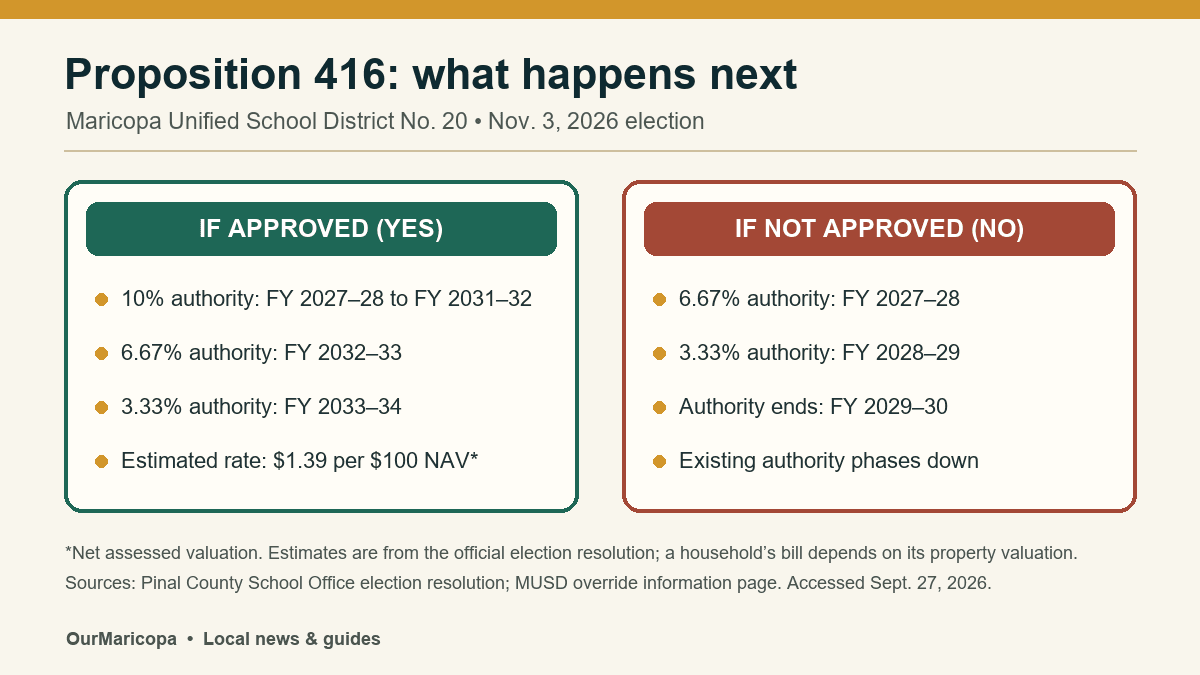
A yes vote would continue the 10% maintenance and operations override for five fiscal years, beginning in fiscal year 2027–28 and continuing through 2031–32.
The authorization would then step down to 6.67% in fiscal year 2032–33 and 3.33% in 2033–34.
The official election resolution and sample ballot describe a yes vote as continuing the existing budget authority and the associated secondary property tax.
What a no vote would do
A no vote would not end the override immediately. The authority already approved by voters would phase down under state law.
According to the resolution, the district could budget a 6.67% override in fiscal year 2027–28, followed by 3.33% in 2028–29. The authority would end for fiscal year 2029–30 unless voters approved a future measure.
That distinction matters: the Nov. 3 choice is about extending the full 10% authority, while a rejection would trigger a two-year reduction rather than a one-day cutoff.
Two budget numbers that describe different things
MUSD’s override information page says the current fiscal year 2026–27 budget includes about $7.8 million from the override.
The election resolution uses projections for the following fiscal year. It estimates that a full 10% override in fiscal year 2027–28 would total $8,274,144. That document also says the proposed continuation would be $2,758,048 more than the alternate budget for that year.
Those figures are not contradictory. The alternate budget used for the comparison already includes the first year of the existing override’s phaseout, equal to two-thirds of the full authority. The $2.76 million figure is the projected difference between the continued 10% authority and that phase-down budget, while $8.27 million is the projected full override amount.
What the tax estimate means
The resolution estimates a tax rate of $1.39 per $100 of net assessed valuation to fund the full override in fiscal year 2027–28. It says that rate is approximately equal to the current override rate.
MUSD provides an illustration using a home with a limited property value of $167,000. The district says its example works out to about 64 cents per day.
That is an illustration, not a guaranteed bill for every homeowner. An individual tax amount depends on the property’s limited value, classification and net assessed valuation. Future rates can also vary as property values and the district’s tax base change. Voters comparing the measure with their own property bill should use the rate in the official resolution and their current valuation notice rather than relying on the example alone.
What MUSD says the override supports
The district says current override money supports smaller class-size targets, the RAM Academy alternative program and student technology. Those are MUSD’s descriptions of the uses of its current override funding; the ballot question itself asks voters to continue the broader maintenance and operations budget authority.
Residents comparing school options can find district, charter and other local education resources in the OurMaricopa schools directory. Families new to the city may also want the education and enrollment section of the Maricopa new resident guide.
Dates Maricopa voters should know
Monday, Oct. 5: voter registration deadline for the Nov. 3 election
Tuesday, Nov. 3: election day
OurMaricopa’s Oct. 5 voter-registration checklist explains how to verify a registration and where to use official Arizona voter services.
The Pinal County School Office page confirms that Proposition 416 is the Maricopa Unified School District No. 20 maintenance and operations override election. Voters should use the final county election materials for ballot-return or polling instructions because those procedures are not established by the district’s campaign information page.
The shortest accurate summary is this: a yes vote continues the district’s full 10% override authority for five years before a two-year phase-down; a no vote allows the existing authority to phase down over the next two fiscal years and end in fiscal year 2029–30.
Sources
Pinal County School Office — Bond & Override Elections, accessed Sept. 27, 2026.
Pinal County School Office / Maricopa Unified School District No. 20 — Official election resolution and sample ballot for Proposition 416, adopted June 10, 2026; accessed Sept. 27, 2026.
Maricopa Unified School District — Override information, accessed Sept. 27, 2026.