Fire Prevention Week begins Sunday, Oct. 4, with a 2026 focus on the rechargeable devices found throughout modern homes. For Maricopa residents, the week also offers a practical reminder that the city's Fire/Medical Department has a service designed to help people check and maintain their smoke detectors.
Maricopa Fire/Medical's Smoke Detector Program provides non-invasive inspections and basic maintenance. The city describes it as especially useful for residents who have difficulty reaching their alarms or who want guidance on maintenance and safety practices.
The program is a service appointment, not an emergency response. Call 911 for an active fire, smoke emergency or immediate danger.
What Maricopa's smoke-detector visit includes
According to the city's program page, trained staff and volunteers can:
Check the detector's manufacture date and whether it is still within its 10-year lifespan
Replace batteries when the homeowner provides the batteries
Blow dust and debris out of the detector
Record the alarm's make and model
Apply a battery-replacement date sticker when batteries are changed
Conduct a residential risk assessment
Provide fire-safety education materials
The program has clear limits. Maricopa Fire/Medical says it does not install new smoke detectors or perform electrical work. The department also cannot service alarms mounted more than 10 feet above the floor. A licensed handyman or electrician may be needed in those situations.
Residents can use the appointment link on the city's Smoke Detector Program page. The page also lists Community Risk Reduction Specialist Daniel Wehle at 520-217-3021 for more information.
OurMaricopa's Community & Public Services directory includes the Fire/Medical administration office and local fire stations for people looking for department contact information.
A five-minute smoke-alarm check at home
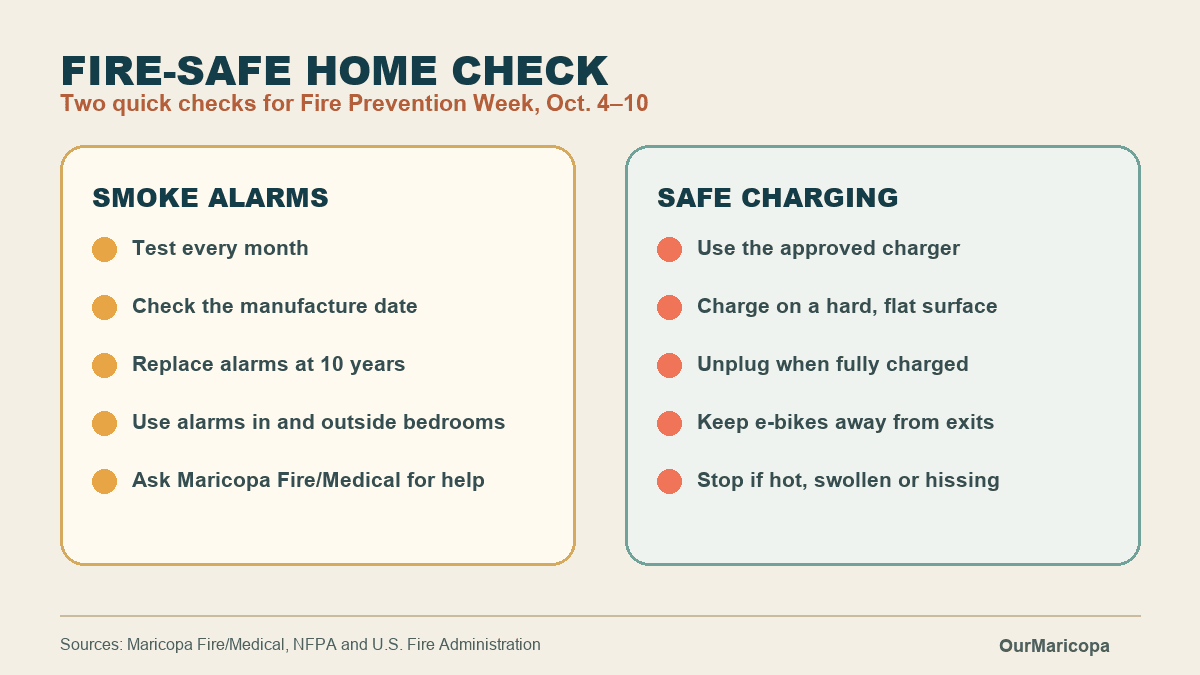
The U.S. Fire Administration recommends alarms inside every bedroom, outside each separate sleeping area and on every level of the home. It also recommends testing alarms monthly and replacing the entire unit 10 years after its manufacture date.
That means the useful date is on the back of the detector, not the date a resident remembers moving into the home.
A simple weekend check can cover four questions:
Does every alarm sound when the test button is pressed?
Is there an alarm inside and outside the sleeping areas and on each level?
Is any alarm 10 years old or older?
Can everyone in the home hear or otherwise receive the alarm signal?
Only a qualified electrician should install or alter a hardwired alarm. People who are deaf or hard of hearing may need devices with strobes, vibrating pads or other alert features.
This year's theme: charge devices more safely
The National Fire Protection Association says Fire Prevention Week runs Oct. 4–10. Its 2026 theme, “Charge into Fire Safety: Safe Charging is a Superpower,” centers on lithium-ion batteries in phones, laptops, tools, toys, e-bikes and other rechargeable products.
The advice is practical:
Use the cord and charger supplied with the device, or one approved by the manufacturer.
Charge devices on a hard, flat surface rather than a bed, couch or pillow that can trap heat.
Unplug the device after it is fully charged.
Charge larger items such as e-bikes, scooters and power tools outside when possible, without blocking a doorway or escape route.
Stop using a battery if it becomes unusually hot, swells, leaks, smells strange, smokes, or makes popping or hissing sounds.
Take lithium-ion batteries to an appropriate recycling location rather than placing them in household trash.
The U.S. Fire Administration also advises keeping batteries out of direct sunlight and hot cars. That point is especially relevant in the Arizona desert even after the peak summer heat has passed.
One useful goal for the week
Residents do not need to rebuild an entire safety plan in one afternoon. A reasonable Fire Prevention Week goal is to test every alarm, photograph each manufacture date for household records and move routine charging off soft furniture.
Anyone who cannot comfortably reach an alarm can then decide whether to request the city's service appointment or call a qualified professional for work outside the program's limits.
Sources
City of Maricopa Fire/Medical — “Smoke Detector Program.” https://www.maricopa-az.gov/Departments/Fire-Medical-Department/Community-Risk-Reduction/Smoke-Detector-Program. Accessed Oct. 3, 2026.
City of Maricopa — “Fire / Medical Department.” https://www.maricopa-az.gov/Departments/Fire-Medical-Department. Accessed Oct. 3, 2026.
National Fire Protection Association — “NFPA charges into Fire Prevention Week.” https://www.nfpa.org/en/about-nfpa/press-room/news-releases/2026/nfpa-charges-into-fire-prevention-week-with-joey-gase-at-nascar-races-in-las-vegas-and-charlotte. Published Sept. 30, 2026; accessed Oct. 3, 2026.
National Fire Protection Association — “Charge into Fire Safety” 2026 tip sheet. https://content.nfpa.org/-/media/Project/Storefront/Catalog/Files/Fire-Prevention-Week/2026/FPW26_Tip-Sheet.pdf. Accessed Oct. 3, 2026.
U.S. Fire Administration — “Smoke Alarms.” https://www.usfa.fema.gov/prevention/home-fires/prepare-for-fire/smoke-alarms/. Last reviewed Sept. 28, 2026; accessed Oct. 3, 2026.
U.S. Fire Administration — “Battery Fire Safety.” https://www.usfa.fema.gov/prevention/home-fires/prevent-fires/batteries/. Accessed Oct. 3, 2026.